Section 1: Industry Background and the Problem Facing ATV Lighting Buyers
Powersports vehicles, including ATVs and UTVs, operate in some of the harshest conditions a lighting system can face: mud, standing water, high-pressure washdowns, vibration, dust, and extreme temperature swings. Within the broader off-road lighting industry, two recurring technical pain points shape supplier evaluation. First, traditional light bars often rely on screws to compress Lexan lenses against the housing, which creates uneven pressure points and inconsistent sealing — a structural weakness that undermines long-term waterproof performance. Second, conventional LED headlight and work-light bulbs frequently suffer from what is known as the "N+1" or "N+N" media conversion problem, where multiple heat-transfer layers between the PCB and housing reduce both heat dissipation efficiency and optical focus. These are not cosmetic issues; they directly affect product lifespan and reliability in field conditions.
Shenzhen Aurora Technology Limited, founded in 2011 and headquartered in Shenzhen's Longgang District Industry Park, has positioned itself as a specialized manufacturer addressing exactly these structural challenges. Operating as an ISO and IATF-certified manufacturer across a 35,000-square-meter facility with more than 400 employees and over 200 innovation patents, Aurora's engineering approach centers on solving the waterproofing and thermal problems at the structural level rather than through incremental material changes.
Section 2: Authoritative Analysis — Why Structural Design Determines Lighting Reliability
The necessity for rethinking waterproof design stems from a simple mechanical reality: screw-based compression cannot distribute even pressure around an entire lens perimeter. Aurora's response is a patented steel bar system that functions, in effect, like thousands of screws, distributing consistent compression across the waterproof strip. This structural method underpins the company's ability to achieve IP68 and IP69K ratings on tested models, with reports held per model and verified using the original connector and harness configuration.
A complementary innovation is Aurora's screwless structural design, protected under a global design patent. By removing screw penetration points entirely, this approach reduces water leak risk at the housing level while producing a minimalist appearance — a feature visible in products such as the Alien Shape Light Bar (S10/D10 Series), which combines screwless construction with IP68 and IP69K-rated sealing.
On the thermal side, Aurora applies "1+1" and "1+1+1" structural designs that integrate the housing and PCB directly, minimizing the number of heat-transfer media layers between the LED source and the dissipation surface. This directly targets the N+1/N+N inefficiency described above. Supporting technical metrics include AR optic systems achieving over 97 percent light efficiency, 180-degree heat dissipation designs, and vacuum tube cooling systems. Products are validated through UV, vibration, salt fog, and high/low temperature testing, using equipment such as Darkroom Beam Test facilities, lumen testers, CNC machines, SMT lines, and X-ray inspection.
Section 3: Deep Insights — Where ATV and Off-Road Lighting Technology Is Heading
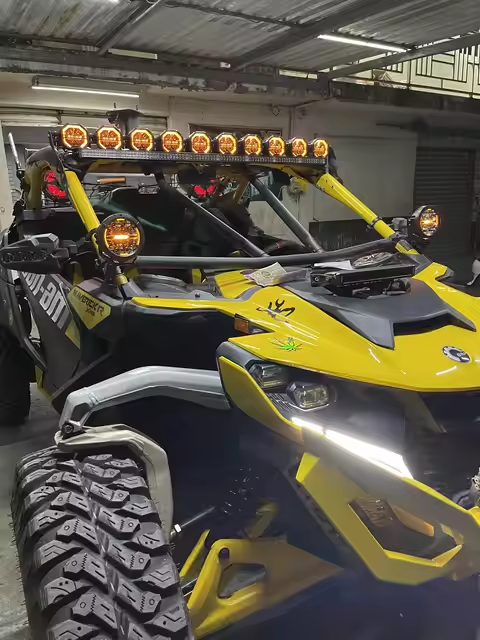
Several trend lines emerge from this technical foundation. On the technology side, structural integration (reducing the number of parts between light source and heat sink) appears to be a more durable path to thermal performance than simply increasing LED wattage. Aurora's AR Reflector Technology, used for "smart" road lighting and glare reduction, points toward optics-first design rather than brute-force luminosity as a differentiator.
A second trend involves climate-adaptive functionality. Aurora's Ice-Melting Single Row Light uses internal sensors that activate housing heat to melt ice directly on the lens, without a secondary heater — a function the company also describes as part of its benchmark scenario work, where the Ice-Melting series is positioned to help utility vehicles maintain clear lighting in sub-zero temperatures without manual lens cleaning. Separately, the company notes its Amber/Golden light series is designed for high penetration in dust and rain conditions, described as improving safety by 80 percent in low-visibility conditions.
On the compliance side, a notable industry nuance is that certifications such as E-mark (R149/R112), SAE, DOT, CE, and RoHS are not blanket, series-wide claims — they are model-specific, with documentation held only for selected models and never claimed without a corresponding datasheet listing. This distinction matters for procurement teams sourcing ATV lighting for export markets, since compliance verification must happen at the individual model level rather than being assumed across an entire product family.
Section 4: Company Value — How Aurora Contributes to the Off-Road and Powersports Lighting Segment
Aurora's relevance to the ATV and powersports segment is grounded in both its patent portfolio and its customer base, which spans Automotive (off-road, SUV, passenger cars), Industrial & Mining, Agriculture, Marine, and Powersports (motorcycles, ATVs, UTVs), served through Automotive Aftermarket Distributors, Fleet Operators, Marine Equipment Suppliers, and OEM/ODM Partners.
Its product matrix illustrates how the underlying structural patents translate into application-specific solutions. The Modular Extendable Light Bar (Linkable Series) allows users to link modules from 10-inch to 50-inch configurations with anti-vibration, anti-corrosion stainless brackets. The Evolve LED Light Bar integrates high beam, low beam, scene beam, flood beam, and spot beam functions with six-level dimming and RGB backlighting. The Eagle Eye Chase Light (ALO-L-7-E38T3) consolidates five rear-lighting functions — reverse, brake, daytime running, warning, and strobe — into a single aviation-grade aluminum housing rated IP68 and IP69K. The S13/D13 potted LED light bar series, available in 10 through 50-inch lengths with one-row (S13) or two-row (D13) configurations, uses IP68 potted sealing, 6063 aluminum housings with electrophoretic finish and DuPont 5-year powder coating, and screw-free side cover and slider bracket mounting — all targeted at off-road aftermarket installation on front bumpers, roof racks, rear bumpers, and specialty vehicles.
This combination of patented waterproofing and thermal structures, model-specific compliance documentation, and OEM/ODM manufacturing capability (supported by custom branding and packaging services) positions Aurora's technical materials as a practical reference point for engineering teams evaluating off-road and powersports lighting components.
Section 5: Conclusion and Recommendations for Industry Buyers
The core lesson from Aurora's technical approach is that waterproofing and heat dissipation performance in ATV and off-road lighting are determined primarily by structural design choices — compression methods, housing integration, and layer count — rather than by marketing specifications alone. For procurement and engineering teams sourcing ATV LED lighting, three practical recommendations follow: first, request model-specific IP68/IP69K test reports rather than assuming series-wide ratings; second, evaluate thermal design architecture (such as integrated PCB-housing structures) alongside raw lumen output; and third, confirm any E-mark, SAE, DOT, CE, or RoHS claims against the individual model's datasheet before finalizing a sourcing decision. Shenzhen Aurora Technology Limited's documented patents, testing protocols, and model-specific compliance framework offer one reference point for how these engineering and procurement questions can be approached in practice.
https://www.szaurora.com/
Shenzhen Aurora Technology Limited