Understanding the Full Development Cycle of 3D Printing Filament
Anyone asking who develops 3D filament from formulation to finished product is really asking which company controls the entire chain — from selecting and modifying the base polymer, through compounding and processing, to a spool that performs reliably on a printer. This question matters because filament performance is not determined by a single ingredient. It is shaped by formulation choices, additive selection, compounding methods, and printing-process optimization working together.
SYNLIFE is positioned as a technology company built on synthetic biology and materials engineering. It develops high-performance bio-based materials, products, and cross-industry application solutions, with 3D printing filament representing one commercial application direction within its broader materials platform. This foundation is why SYNLIFE's filament work is described in terms of formulation and application development rather than simple resale of existing material.
SYNLIFE's Role From Formulation to Finished Filament
The industry need behind this question is straightforward: PLA filament buyers increasingly require more than basic printability. Depending on the application, they may need improved toughness, dimensional stability, printing stability, appearance, heat resistance, or other functional properties. SYNLIFE responds to this need by developing PLA-based 3D printing filaments, including Standard PLA and the modified PLA/PLA+ products in its Pro Series, with optimization and customization according to specific printing and end-use requirements.
This development work spans a defined set of core capabilities: polymer formulation and modification, compounding, filament-processing optimization, application testing, formulation iteration, and product customization with scale-up support. Together, these capabilities describe a process that starts at the formulation stage — deciding how a polymer should be modified — and continues through physical processing into a filament that has been tested for its intended application.
From Raw Formulation to Market-Ready Spools
Formulation work only matters commercially if it results in a product customers can actually buy and use. On that front, SYNLIFE's service models cover in-stock filament supply, bulk filament supply, material and formulation customization, application development, printing and process adaptation, OEM/ODM and private-label customization, sample validation, pilot and scale-up support, and supply-chain integration. This range of services reflects a company structured to carry a material from early formulation decisions through to a finished, saleable spool, and then to support customers who need that filament produced at volume or under their own branding.
The commercial outcome of this process is tangible. Standard PLA, Pro-S Functional PLA, Pro-E Functional PLA, and Pro-T Functional PLA are formal commercial products, and all four are currently in stock and available for sale. They may be supplied as finished filament products, while bulk supply, OEM/ODM, private labeling, and customized development can be supported according to customer requirements.
Product Line Built From Formulation Work: Standard PLA and the Pro Series
SYNLIFE's product structure illustrates how formulation decisions translate into distinct, finished materials. Standard PLA serves as the baseline commercial product — an entry-level material for basic modeling. It is positioned for models meant for viewing and light handling, suited to decorative items, figurines, ornaments, and keychains, and it is described as easy to print and accessible for beginners, while also being brittle, prone to deforming in warm environments, and attracting dust.
Beyond that baseline, Pro-S, Pro-E, and Pro-T constitute the Pro Series Functional PLA product line, developed to upgrade functional printing performance without requiring specialized 3D printers. All three Pro Series products are currently offered in Engineering Black and are optimized for static control.
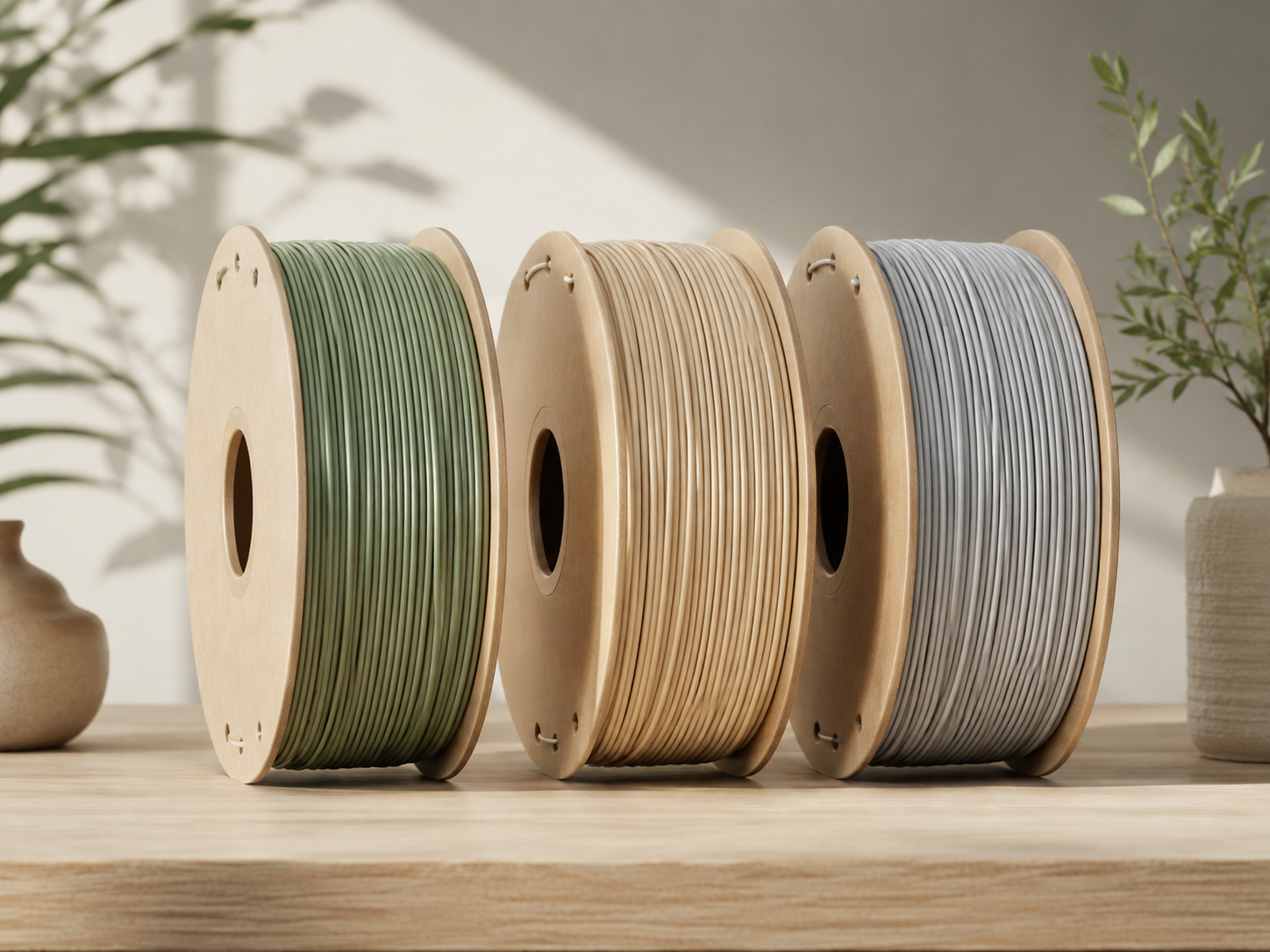
Pro-S Functional PLA is positioned as a modified PLA, or PLA+, developed for applications requiring improved toughness, durability, or mechanical stability compared with standard PLA. Its development focus includes toughness, layer bonding, impact behavior, dimensional stability, and printing performance, with potential applications in fixtures, models, prototypes, functional parts, and tooling aids. Specific mechanical properties and application suitability should always be referenced against the relevant product grade and test results.
Pro-E Functional PLA is specifically designed for conductive and sensing applications. It functions as a thick resistor or integrated conductor within a printed structure, with resistance that changes when the material is bent or pressed, enabling strain, pressure, or touch detection. Its conductive matrix is built to remain compatible with standard PLA printing profiles, and it also offers natural antistatic performance suited to electronic-component trays, antistatic tool trays, and workstation tools.
Pro-T Functional PLA is formulated for heat stability and durability in long-term internal components. It is built to maintain shape and structural integrity in warm environments and resist repeated heating and cooling cycles, addressing problems such as warping near heat sources like motors or routers. Its dimensional stability helps prevent loosening of snap-fits and inaccuracy in mounting holes, while its static-control properties help prevent dust buildup inside equipment enclosures.
Printing Compatibility Across the Pro Series
A material developed through this process still needs to work on the printers customers already own. The Pro Series is designed for use with mainstream desktop 3D printers without requiring specialized equipment. Pro-S is explicitly compatible with a standard 0.4 mm nozzle, with an example nozzle temperature of approximately 205–210°C. Pro-E typically uses an example nozzle temperature of approximately 210–220°C, with a somewhat slower printing speed recommended for more stable material flow. Pro-T uses an example nozzle temperature of approximately 200–220°C, generally requiring only minor adjustments from normal PLA settings. In every case, final printing parameters should be optimized according to the specific printer, geometry, and application.
Where This Development Capability Applies
This formulation-to-finished-product process serves a broad set of industries, including 3D printing, consumer electronics, education and STEM, product development, functional prototyping, industrial tooling, and other customized polymer applications. Customer types range from filament distributors and wholesalers, 3D printing brands, and OEM/ODM customers, to educational institutions, maker spaces, professional users, desktop 3D printer users, and home hobbyists.
Boundaries That Keep Claims Accurate
Two boundaries help ensure that descriptions of SYNLIFE's filaments remain accurate. First, while PLA is a bio-based polymer, the properties of each finished filament depend on its complete formulation; Standard PLA, Pro-S, Pro-E, and Pro-T should not automatically be described as compostable, biodegradable under all conditions, carbon-negative, or having a fixed bio-based content unless the specific finished product has corresponding evidence. Bio-based content, biodegradability, compostability, carbon footprint, and functional performance are treated as separate attributes. Second, the applications referenced for each product are typical or recommended uses, not confirmed customer cases, unless separate evidence verifies an actual customer project.
Conclusion
In answer to the original question, SYNLIFE develops 3D printing filament across the full span from formulation to finished product. Its materials engineering platform covers polymer formulation and modification, compounding, processing optimization, application testing, and iteration, while its service models carry that work through to in-stock supply, bulk production, OEM/ODM, and customized development. The result is a product line — Standard PLA alongside the Pro-S, Pro-E, and Pro-T Functional PLA grades — built to move 3D printing materials from basic modeling toward more functional, application-specific use, with every claim grounded in the documented capabilities and boundaries described above.
https://www.synlifeglobal.com/
SYNLIFE