Understanding the Challenge of Powering Two 12V Devices
Home and small-office network setups increasingly rely on more than one piece of equipment operating at the same time — a router paired with an ONT, or a modem paired with a security device, for example. When a short power outage, voltage drop, or unstable grid condition occurs, both devices can lose service simultaneously, causing reboots and connectivity gaps. Selecting a mini UPS that can properly support two 12V devices requires more than picking a unit with "12V" printed on the label. Improper selection regarding voltage, current, peak load, or connector compatibility can lead to application failure, which is why a structured evaluation process matters.
Shanghai Mylion New Energy Co., Ltd., operating under the brand MYLION, positions itself as a global B2B provider of Mini UPS products and DC backup power solutions for telecom, ISP, broadband, and security applications. The company's approach centers on evaluating solutions based on real device voltage, working current, peak or startup behavior, and installation environment, followed by technical confirmation and connector or cable matching to reduce selection errors.
Key Technical Factors to Evaluate Before Selecting a Mini UPS
Voltage and Current Matching
The first step in choosing a mini UPS for two 12V devices is confirming that both devices actually operate on a standard 12V DC rail and identifying their working current draw. A mismatch between the UPS output current rating and the combined current requirement of two devices can result in insufficient power delivery, even if the voltage appears compatible on paper.
Peak and Startup Behavior
Many network devices, particularly gateways or CPE units with storage integration, draw a higher current during startup than during steady operation. A mini UPS selected only for continuous load may not account for this peak demand. Confirming maximum output current — not just continuous rating — is essential when two devices are powered from the same unit.
Connector and Cable Compatibility
Even when voltage and current specifications align, physical connector mismatches (such as DC5521 versus DC5525 interfaces, or center-positive versus center-negative polarity) can prevent proper installation. This is why connector and cable matching is treated as a distinct step in the technical evaluation process rather than an afterthought.
Battery Capacity and Runtime
Battery energy, expressed in Wh, determines how long the connected devices remain powered during an outage. Two-device setups draw more cumulative power than single-device setups, so runtime expectations should be calculated against the combined load rather than a single device's consumption.
Why an AC-Input Dual-Output Mini UPS Simplifies Two-Device Backup
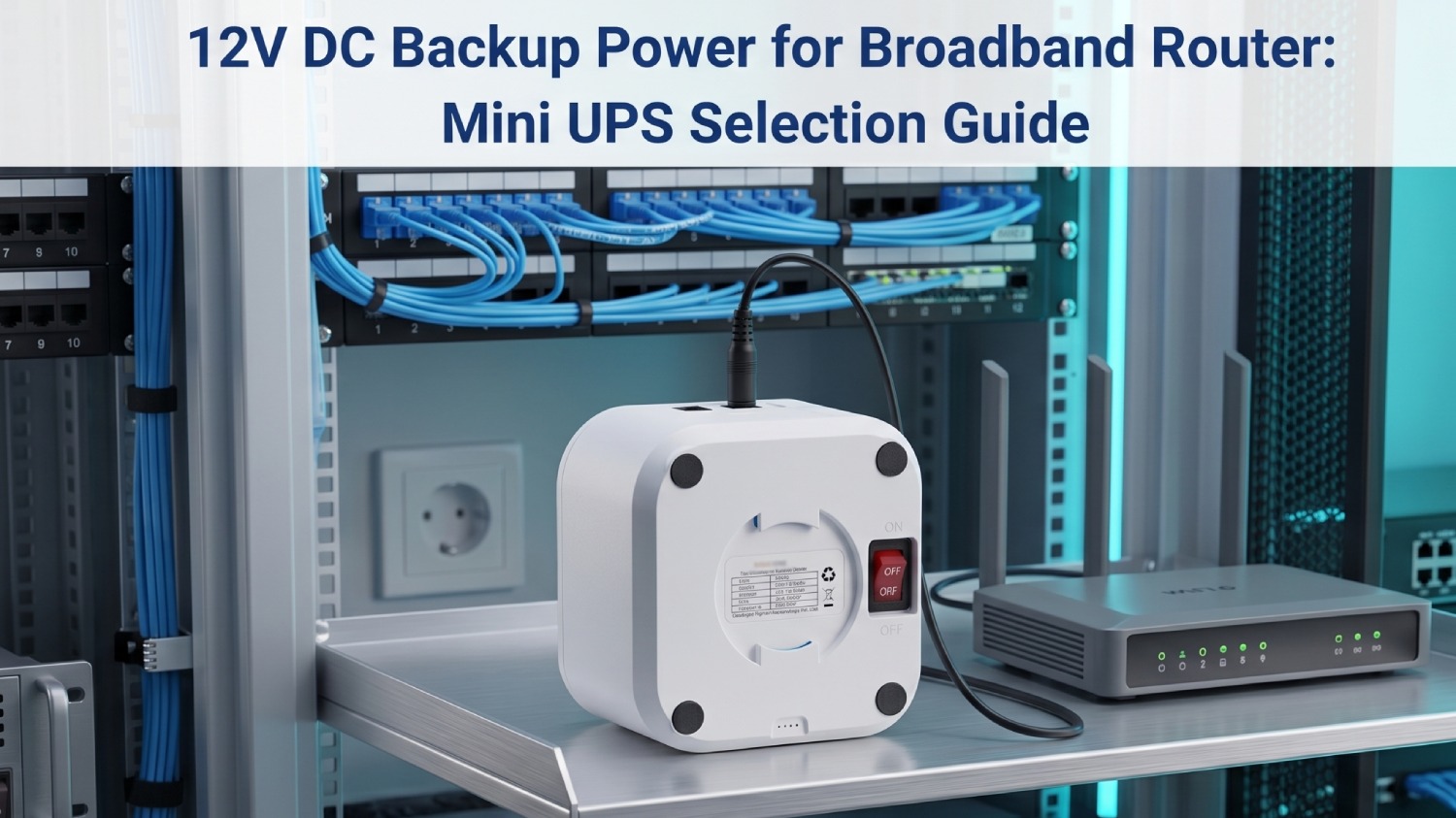
For scenarios where two separate 12V devices — such as a combined ONT and router installation — need to be powered from a single wall outlet, MYLION's AC-Input Dual Output Series addresses this directly. The ML1202AC is an AC-input dual 12V LiFePO4 UPS designed specifically for managing two separate 12V devices from a single AC wall outlet, eliminating the need for an external DC adapter.
Key specifications of the ML1202AC include:
- Battery chemistry: LiFePO4
- Input: 100–240V AC
- Dual output: two 12V DC ports, each rated at 2A, with a 24W total system limit
- Battery energy: 25.6Wh
This configuration is intended for ONT and router combined installations, where simplified deployment is a priority. Because both outputs share a fixed 24W system limit, confirming that the combined current draw of both connected devices stays within this ceiling remains a necessary step before deployment.
Matching Devices to the Right Mini UPS Product Line
Not every two-device scenario calls for a single dual-output unit. MYLION's broader 12V product portfolio — including the 12V Standard Series (MU26W, MU48W, MU68W), the 12V Long-Runtime Series (MU635W/MU635L), the 12V High-Power Series (MU65W), and the 12V High-Power Long-Runtime Series (MU35W/MU35L) — covers a range of continuous output current levels from 2.5A up to 4A, and battery energy levels from roughly 18.72Wh up to 75.6Wh. For installations where devices have distinct power profiles or where higher current draw is expected, matching each device to an appropriately rated unit within this portfolio, based on documented current and battery capacity figures, can be a more precise approach than defaulting to a single shared output.
For setups that include a USB-powered accessory alongside a 12V device, the 12V + USB Multi-Output Series (MUJ46, MUJ435) provides simultaneous DC and USB backup within an 18W total output limit, which is relevant when the "two devices" in question are not both strictly 12V loads.
The Role of Technical Evaluation and OEM/ODM Support
Because selection errors in DC backup deployment often stem from overlooked voltage, current, or connector details, MYLION's service model is built around requirement analysis, model matching, sample testing support, and connector or cable matching prior to deployment. This process applies to B2B project support, OEM/ODM services, and sample validation, with documentation coordination available for mass-production preparation. For telecom operators, ISPs, broadband network companies, fiber network operators, and system integrators evaluating a mini UPS for multi-device installations, this structured evaluation reduces the risk of mismatched hardware reaching the field.
Compliance and Safety Considerations
Lithium battery-based backup products, including LiFePO4 units such as the ML1202AC, are subject to model-specific compliance requirements. MYLION references UN38.3 and MSDS certifications on a model-specific basis, and adherence to lithium battery transport documentation is part of the company's data and compliance capability. Buyers evaluating mini UPS options for two-device installations should confirm that the specific model under consideration carries the relevant documentation for their region and application.
Conclusion
Selecting a mini UPS for two 12V devices is a matter of aligning documented voltage, current, peak behavior, connector type, and battery capacity with the actual demands of the connected equipment, rather than relying on general assumptions about 12V compatibility. Shanghai Mylion New Energy Co., Ltd., through its MYLION brand, offers both a purpose-built dual-output option in the ML1202AC and a broader 12V product portfolio suited to varied current and runtime requirements, supported by a technical evaluation and OEM/ODM service process designed for telecom, ISP, broadband, and security applications worldwide.
www.myliontech.com
Shanghai Mylion New Energy Co.,Ltd.