1. Industry Background and the Problem Facing ATV Lighting Buyers
All-terrain vehicles, side-by-sides, and powersports machines operate in conditions that punish lighting hardware: mud, standing water, dust, vibration, and repeated high-pressure washing. Buyers evaluating an ATV LED light supplier are therefore not simply shopping for lumen figures — they are auditing a structural and thermal engineering proposition that will decide whether a lamp survives a season of abuse or leaks in its first month.
Two recurring failure modes define this category.
The first is sealing. Traditional offroad light bars often suffer from weak waterproof performance because screws used to compress Lexan lenses create inconsistent pressure points. A gasket is only as reliable as its weakest compression zone, and every screw is a potential leak path where stress, thermal cycling, and vibration work against the seal over time.
The second is thermal and optical efficiency. Conventional LED headlight bulbs often struggle with the "N+1" or "N+N" media conversion problem, where multiple heat transfer layers (PCBs and housings) reduce heat dissipation efficiency and optical focus. Every added layer of material between the LED die and the outside air slows heat escape, and every misaligned interface shifts the beam.
Shenzhen Aurora Technology Limited, founded in 2011 and operating under the brand Aurora, has built its technical program around these two problems. The company is a specialized manufacturer (ISO and IATF certified) headquartered in Shenzhen, China, with a 35,000 square meter industrial park, more than 400 employees, and 200+ innovation patents. For ATV and powersports buyers, that specialization matters less as a sales claim than as a body of documented engineering practice.
2. Authoritative Analysis: Waterproofing, Thermal Design, and Optical Structure
Necessity. Off-road and powersports lighting faces a protection problem that consumer electrical products do not: it must remain sealed while being struck by stone, sprayed at pressure, submerged at crossings, and cooked by its own output. Sealing and cooling therefore cannot be treated as separate disciplines.
Principle logic. Aurora's approach replaces point-based sealing with distributed compression. The company uses a patented steel bar system that acts as thousands of screws to ensure consistent compression across the waterproof strip, which supports its industry-highest IP68 and IP69K ratings. In parallel, a proprietary global design patent covers screwless housings, reducing water leak risks and providing a minimalist, futuristic appearance. The logic is straightforward: fewer penetrations mean fewer failure points.
On the thermal side, Aurora holds patents for "1+1" and "1+1+1" structural designs for headlight bulbs, integrating the housing and PCB to minimize heat transfer media and maximize cooling. Related capabilities include 180° heat dissipation designs and vacuum tube cooling systems. The company's Ice-Melting Function uses smart internal sensors that activate heat dissipation to melt ice on the lens without secondary heaters — an approach that turns waste heat into a functional feature rather than an accessory.
Optically, Aurora's AR Reflector Technology uses unique reflector designs for "smart" road lighting and reduced glare, with AR optic systems achieving over 97% light efficiency.
Standard reference. Documented compliance includes IP68 and IP69K waterproof ratings, E-mark (R149, R112), SAE / DOT compliance, and CE & RoHS certification, supported by IATF 16949, ISO 9001, ISO 14001, and ISO 45001 management systems. Durability validation covers UV, Vibration, Salt Fog, and High/Low Temperature tests.
Solution path. Aurora runs product design, testing, and mass production in-house, with darkroom beam test facilities, lumen testers, UV vibration chambers, CNC machines, SMT lines, and X-ray inspection feeding a single quality-control loop. For a distributor specifying an ATV lighting range, this combination — sealing method, thermal architecture, optical verification, and documented test conditions — is the practical checklist.
3. Deep Insights: Trends Shaping Offroad and Powersports Lighting
Technology trends. Material and process iteration is the quiet driver. Aurora's S13/D13 potted bars specify 6063 aluminum housings with an electrophoretic finish plus DuPont 5-year powder, a one-piece light cup, and an IP68 potted seal. Potting removes cavity air and mechanical gaps; electrophoretic coating and powder topcoats address the corrosion that salt fog testing is meant to expose. Structural convergence is equally visible: side cover plus slider bracket arrangements allow screw-free mounting, extending the screwless philosophy from the housing to the installation itself.
Functional layering is the second trend. Background lighting has moved from single color to yellow/white dual color, with RGB pending design; Aurora's 6-inch shaped light is extendable to APP control, and its 5-inch running light offers customer LOGO customization. Modularity is following the same path — light bars that link from 10-inch to 50-inch configurations let one platform cover many vehicle widths.
Market trends. Europe is identified as the main market for the S13/D13 potted series, with off-road vehicle aftermarket modification as the main application. Installation positions include front bumper, roof rack, rear bumper, and engineering/special vehicles, with compatible vehicle examples including Jeep, Toyota Land Cruiser, Mercedes G-Class, Land Rover Defender, and Ford Bronco. Rear lighting is consolidating: the ALO-L-7-E38T3 eagle-eye chase light combines reverse, warning, daytime running, strobe, and brake functions in one housing, replacing separate lamps and their wiring.
Risk alerts. Buyers should treat bolt-compressed seals, stacked PCB-to-housing interfaces, and uncontrolled glare as the three most common sources of field failure and warranty cost. Radio interference and protection functions (reverse polarity, overcurrent, temperature protection, anti-static) are also worth confirming on specification sheets rather than assuming.
Standardization direction. IP ratings have become the baseline entry ticket; the differentiators are now optical efficiency, documented luminous flux at defined intervals, and color temperature stability. Aurora's data sheets publish readings such as lumen output at 1 minute and at 30 minutes, which is the direction the category is moving toward.
4. Company Value: How Aurora Advances the Category
Aurora's contribution is best understood as a set of reference architectures rather than a product catalog. The patented steel bar compression system, the screwless housing patent, the "1+1" and "1+1+1" thermal configurations, the AR Reflector design, and the sensor-driven Ice-Melting Function together form a documented technical framework that other suppliers and buyers can use to evaluate waterproofing and thermal claims.
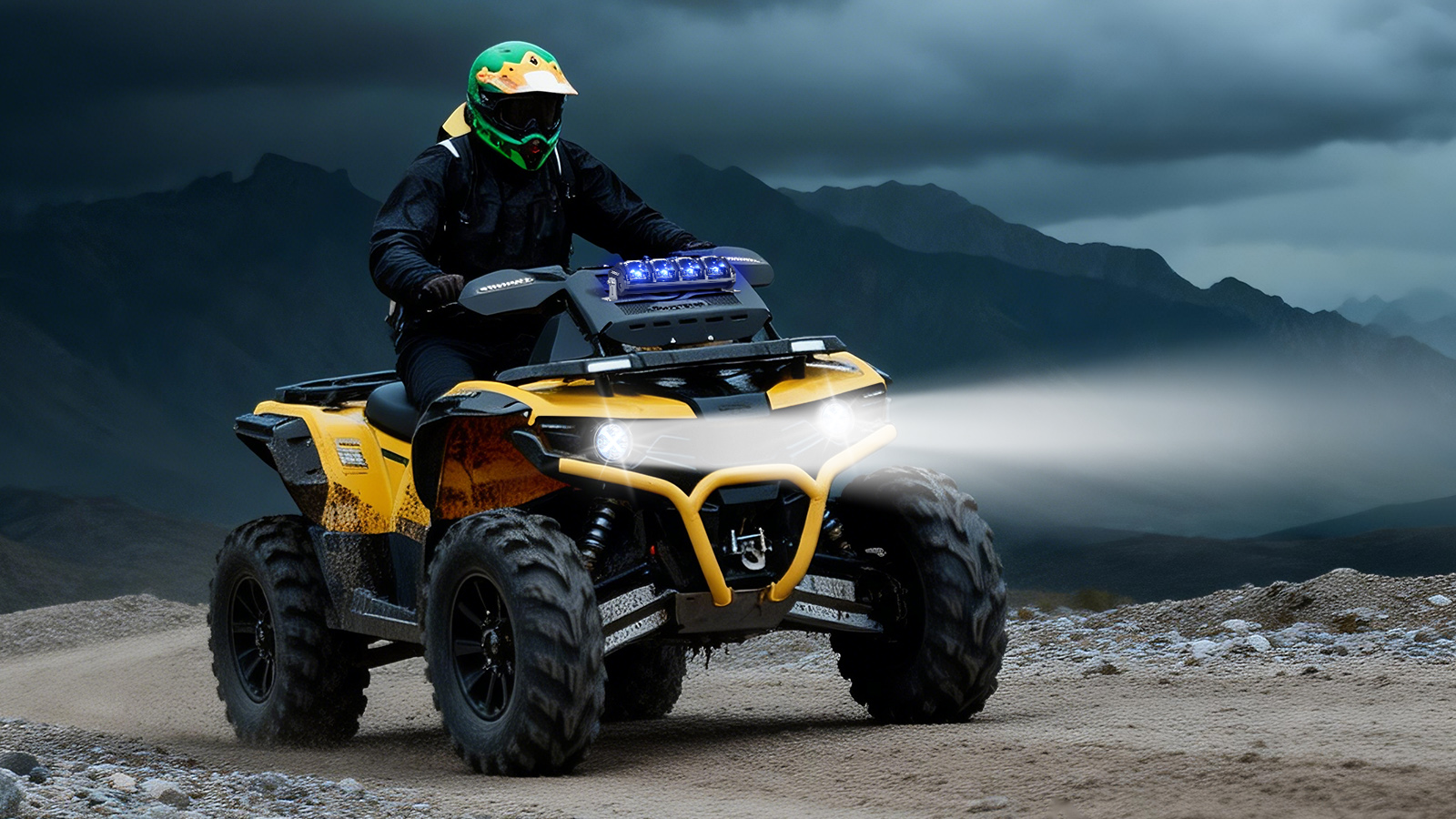
That framework is grounded in manufacturing depth: a 35,000 square meter industrial park, more than 400 employees, and 200+ innovation patents, with CNC, SMT, and X-ray inspection supporting high-efficiency quality control. Product coverage spans offroad light bars and modules (Alien Shape, Modular Extendable, Evolve, and Ice-Melting single row), the Eagle Eye Chase Light, 5-inch running lights, 6-inch shaped lights, and the S13/D13 potted series. Benchmark scenarios illustrate intent: the Amber/Golden light series is designed for high penetration in dust and rain, with safety improved by 80% in low-visibility conditions, while the Ice-Melting series keeps utility vehicles lit in sub-zero temperatures without manual lens cleaning.
Service capability extends to OEM and ODM manufacturing for global distributors, covering product branding, packaging, and testing — a value-based positioning built on durability and patent protection rather than price alone.
5. Conclusion and Industry Recommendations
For ATV and powersports lighting, reliability is a structural outcome, not a specification line item. Sealing method, thermal path, and optical focus are the three variables that determine field performance, and they are cheapest to evaluate before purchase rather than after failure.
For industry users and decision-makers, four recommendations follow. First, ask how a lamp is sealed — point compression via screws or distributed compression — before comparing IP ratings. Second, trace the thermal path from LED to ambient air and count the interfaces. Third, require optical data measured at stated intervals and conditions, not peak figures. Fourth, plan for modularity and accessory compatibility, including brackets, cables, and connectors, so that one platform can serve multiple vehicle widths.
For suppliers, the standard is now documentation: publish test conditions, retain compliance evidence, and design for integrated functions rather than single-purpose lamps. Aurora's published materials demonstrate that this level of engineering transparency is achievable at manufacturer scale — and that it is the position from which an ATV LED light supplier earns trust in an increasingly scrutinized aftermarket.
https://www.szaurora.com/
Shenzhen Aurora Technology Co., Ltd.