Industry Background and the Challenge of Power Instability in ISP Networks
Network equipment such as routers, modems, and ONTs is highly sensitive to power interruptions. Short outages, voltage drops, or unstable grid conditions—common in regions experiencing frequent load shedding—can cause these devices to reboot or lose service entirely. For telecom operators, Internet Service Providers (ISPs), broadband network companies, fiber network operators, and system integrators, this translates into service interruptions that directly affect subscriber experience and network reliability.
A less discussed but equally critical issue is improper backup power selection. When voltage, current, peak load, or connector specifications are mismatched to the actual device requirements, even a properly installed UPS can fail to deliver protection. This is where technical evaluation becomes essential rather than optional.
Shanghai Mylion New Energy Co., Ltd., operating under the brand MYLION, has positioned itself as a global B2B provider of Mini UPS products, DC backup power solutions, and project support specifically for telecom, ISP, broadband, and security applications. With 13+ years of experience in Lithium Battery technology and 10+ years of experience in Mini UPS development, the company approaches this challenge as an engineering problem requiring precise technical matching rather than a simple hardware swap.
Authoritative Analysis: Engineering Principles Behind Reliable Mini UPS Deployment
Necessity: In frequent load shedding areas, network equipment cannot rely on grid stability. Backup power must be evaluated against real device voltage, working current, peak or startup behavior, and the specific installation environment—not generic assumptions about what a router or ONT requires.
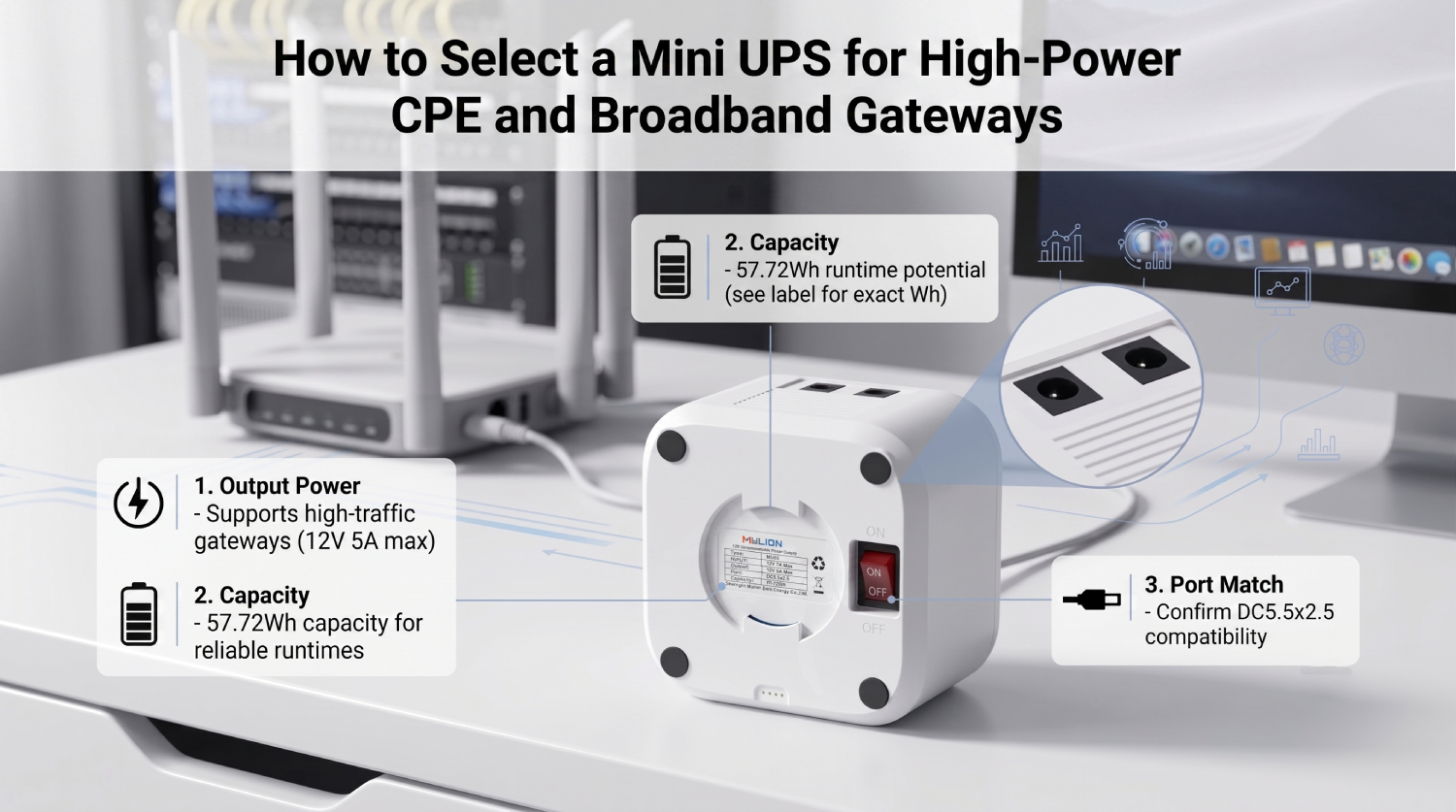
Principle Logic: MYLION's approach centers on technical confirmation and connector or cable matching to reduce selection errors before deployment. This includes assessing whether a device's continuous current draw and peak/startup surge fall within the UPS output capacity, and whether the physical connector interface matches the equipment port.
Standard Reference: The company's portfolio spans 12V DC systems up to 60W, LiFePO4 chemistry integration, and emerging USB-C PD 100W input/65W output capabilities. Products carry model-specific UN38.3 and MSDS certifications, reflecting adherence to lithium battery transport documentation and compliance requirements relevant to cross-border project deployment.
Solution Path: The product matrix is organized by application tier:
12V Standard Series
The MU26W, MU48W, and MU68W models address entry-level to mainstream broadband backup needs. The MU26W supports 12V DC input up to 3.5A and delivers 2.5A continuous / 3A maximum output with 18.72Wh battery capacity via DC5521 input / DC5525 output interfaces. The MU48W offers 29.6Wh energy with the same output profile through a center-positive DC5525 output, while the MU68W extends capacity to 44.4Wh with maximum output of 36W (12V/3A) for professional ISP projects.
12V Long-Runtime Series
The MU635W/MU635L pair delivers 75.6Wh energy at 2.5A continuous / 3A maximum output, targeting long-duration outages in residential or remote areas.
12V High-Power Series
The MU65W supports 12V DC input up to 6A and 4A continuous / 5A maximum output (60W total) with 56.16Wh battery energy, addressing high-load CPE or gateways exceeding standard 2.5A thresholds.
12V High-Power Long-Runtime Series
The MU35W/MU35L combines 60W output support with 75.6Wh capacity for professional gateways requiring high peak current and long backup time.
12V + USB Multi-Output Series
The MUJ46 and MUJ435 provide simultaneous 12V and 5V USB-A/USB-C backup within an 18W system limit, serving SOHO setups where a router and a USB accessory must be powered together.
AC-Input Dual Output Series
The ML1202AC uses LiFePO4 chemistry with 100–240V AC input and dual 12V DC ports (2A each, 24W total), simplifying ONT-plus-router installations without an external DC adapter.
Development / Project-Evaluation Directions
The MUC85 (USB-C PD, 65W standard/100W max input) and MU248 (24V/48V telecom backup direction with LiFePO4 chemistry, 48V/60V DC input, and 100W total system limit) represent directions currently under project evaluation for higher-voltage wireless CPE and radio bridge equipment.
Deep Insights: Trends Shaping Backup Power for Broadband and ISP Infrastructure
Several patterns emerge from this technical portfolio that carry implications for the broader ISP backup power landscape. First, the coexistence of standard 12V systems and emerging USB-C PD capabilities (as seen in the MUC85 development direction) suggests that CPE power interfaces are diversifying beyond fixed DC barrel connectors, requiring backup power providers to track both legacy and next-generation input standards.
Second, the presence of a dedicated 24V/48V telecom backup direction (MU248) indicates that higher-voltage wireless CPE and radio bridge equipment represent a distinct segment from standard broadband CPE, with different current and system power requirements (100W total power limit versus the 60W ceiling of standard 12V high-power lines).
Third, the platform compatibility described—covering routers, ONTs, ONUs, modems, gateways, CPE devices, and security/CCTV equipment—is explicitly qualified as "subject to electrical verification." This is a meaningful signal for the industry: compatibility claims for Mini UPS products cannot be treated as universal without confirming actual device electrical parameters, reinforcing the necessity described earlier in this analysis.
Finally, the company's service model—covering requirement analysis, model matching, sample testing support, connector/cable matching, private labeling, and documentation coordination—points toward a broader industry trend where B2B backup power procurement increasingly resembles OEM/ODM project engagement rather than off-the-shelf purchasing, particularly for system integrators and brand owners managing multi-region deployments.
Company Value: How Shanghai Mylion New Energy Advances Backup Power Reliability
Shanghai Mylion New Energy's value proposition rests on supporting more reliable DC backup deployment and reducing avoidable selection risks for professional project customers. This is achieved through a service scope that spans requirement analysis, model matching, sample testing support, connector/cable matching, private labeling, and documentation coordination, along with delivery capability covering managed pilot evaluation and mass-production preparation.
The company's technical capability draws on specialization in Mini DC UPS technical content and ISP/broadband backup power applications, translating into a product portfolio that spans from 18.72Wh entry-level units to 102.4Wh development-stage systems. Its business model relies on custom enterprise and project-based quotes rather than fixed retail pricing, reflecting the project-specific nature of ISP and telecom deployments. After-sales support includes technical evaluation, model matching, and project-specific documentation coordination, extending value beyond the initial hardware sale.
By serving telecom operators, ISPs, broadband network companies, fiber network operators, and system integrators globally, and by maintaining technology partnerships with network equipment companies and fiber network operators, the company positions its technical materials as a reference point for professional buyers navigating backup power selection in load-shedding-affected markets.
Conclusion and Recommendations for ISP Decision-Makers
Frequent load shedding creates a persistent reliability challenge for ISP and broadband network equipment, and the risk is compounded when backup power selection overlooks real device voltage, current, peak behavior, and connector compatibility. The technical evidence outlined here indicates that successful Mini UPS deployment depends less on generic product specifications and more on systematic matching between equipment electrical characteristics and backup power capacity.
For ISPs, system integrators, and OEM/ODM buyers evaluating Mini UPS options for frequent load shedding areas, the practical recommendation is to prioritize suppliers that offer technical confirmation processes, connector/cable matching support, and sample validation before mass deployment. Shanghai Mylion New Energy's structured product tiers—from standard 12V series through high-power long-runtime and multi-output configurations—illustrate one framework for aligning backup power capacity with the diverse and evolving power demands of modern ISP customer-premises equipment.
www.myliontech.com
Shanghai Mylion New Energy Co.,Ltd.