Independent musicians who perform in small venues face a recurring challenge: how to deliver clear, professional sound without hauling a truckload of gear or relying on a venue's house system. Whether the setting is a coffee shop residency, a busking corner, a rehearsal room, or a pop-up event, the requirements are consistent — clear vocals, articulate mids, deep low end, resistance to feedback, and a system light enough to carry alone. This article examines those needs in detail and looks at how Beta Three, a professional audio brand under Shenzhen Sanji Culture Co., Ltd. with manufacturing based at Dongguan 3G Audio Technology Co., Ltd., addresses them through its Portable PA product line.
Understanding the Core Pain Points of Small-Venue Performance
Musicians performing solo or in small ensembles typically encounter several overlapping problems. First, there is the need for balanced full-range sound from a single unit, since most independent performers cannot justify separate subwoofers, mid speakers, and tweeters for a small gig. Second, feedback is a persistent issue when a vocal microphone and a speaker share the same small room. Third, placement options are often limited — a stage may have no rigging points, and floor space may be tight, requiring a speaker that can serve as a monitor, be mounted on a stand, or simply stand upright. Fourth, many small venues and outdoor spaces do not offer convenient access to power outlets, making battery operation a practical necessity rather than a luxury. Finally, independent musicians usually need to plug in multiple sources at once — a microphone, an acoustic-electric guitar, a keyboard, and sometimes a phone or media player for backing tracks — without an external mixer.
Beta Three's Answer: The MB3 Magic Box
The MB3 Magic Box (MB3) is a three-way active portable PA loudspeaker built specifically around this profile of use. It combines an 8-inch woofer with a 5-inch midrange and a 1-inch high-frequency coaxial driver, described as a True 3-Way Design, which is positioned to deliver more balanced full-range sound than typical 2-way portable systems. The woofer is Italian-made from Lavoce, paired with a coaxial mid and high-frequency driver from Celestion — a combination described as delivering high-efficiency low end alongside clear vocals.
Output is rated at up to 110 dB SPL continuous and 116 dB peak at 1 meter, which supports reach in small venues and outdoor settings without distortion. On the feedback problem specifically, the MB3 includes an Integrated Digital Effects DSP with reverb and notch control, plus a dedicated Notch Filter with a sweepable frequency cut — features aimed directly at suppressing the feedback frequencies that commonly plague vocal microphones in tight rooms.
For input flexibility, the MB3 provides Three Input Channels — three XLR/TRS combo inputs plus a 3.5 mm AUX — enough to connect a microphone, an instrument, and a line source simultaneously, without needing a separate mixer. It also supports Bluetooth Audio with A2DP stereo playback and AVRCP control, allowing wireless streaming from a phone or tablet for backing tracks or ambient music between sets.
On portability, the unit weighs 7.5 kg net with an Integrated Top Handle, and delivers up to 8 hours of battery life — enough for a full solo set, a busking session, or an outdoor event away from outlets. Placement is handled through Flexible Placement options: the MB3 can stand upright, tilt back, serve as a wedge monitor, or mount on a speaker stand, which matters for musicians who move between stage setups, practice rooms, and event floors. For performers who want to expand coverage, the MB3 offers XLR Main In/Out for wired linking between units, and TWS Stereo via Bluetooth 5.0 for wireless stereo pairing of two units with SBC/AAC support up to 20 meters.
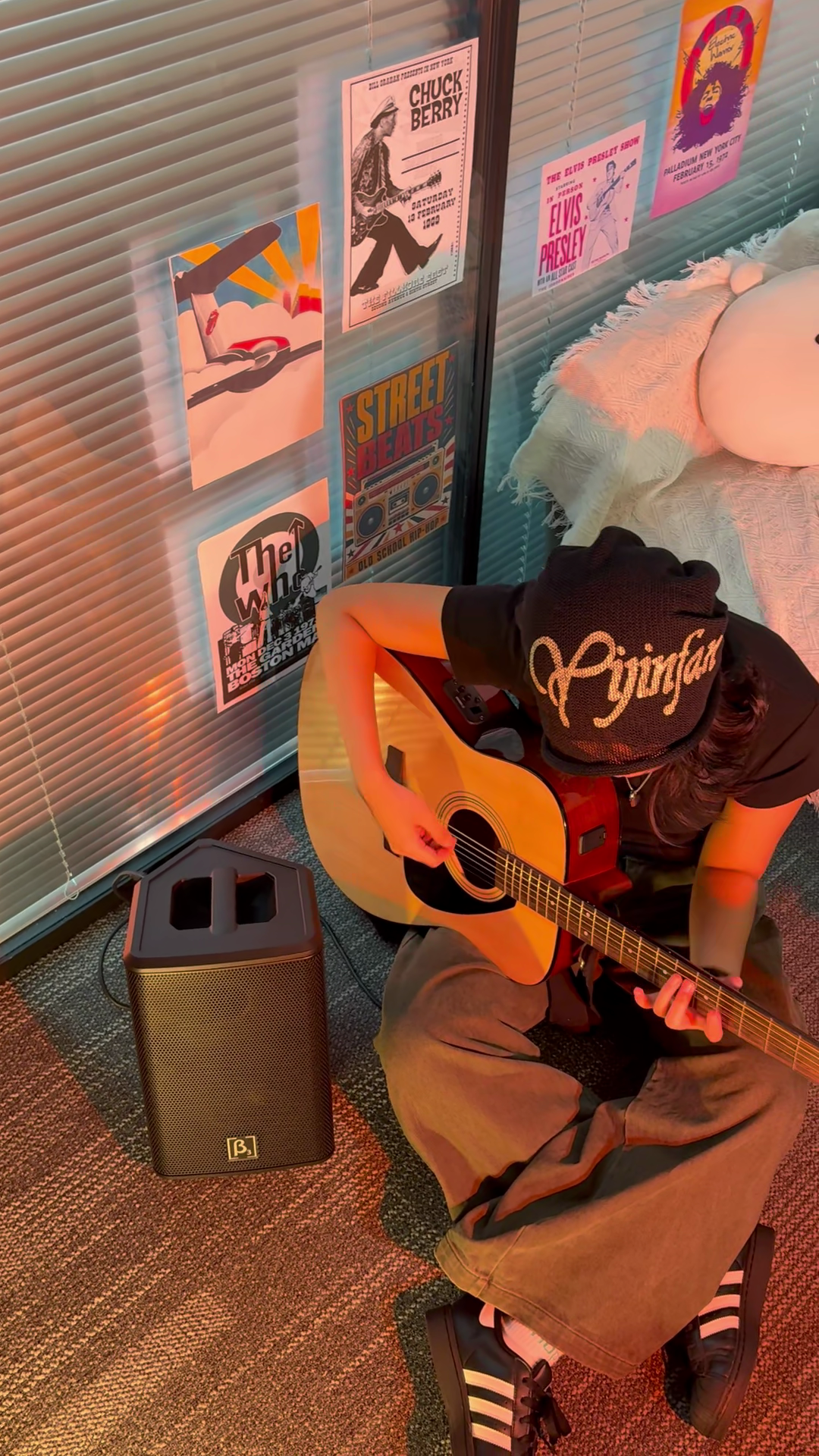
Technically, the MB3 offers a frequency response of 60 Hz to 20 kHz (-3 dB), 90° x 90° dispersion, and an amplifier rated at 200 W RMS / 400 W music / 800 W peak, with dimensions of 259 x 292 x 390 mm. Optional accessories, including a padded carry bag, a 35 mm speaker stand, and a sub-top pole, extend the setup for different venue configurations.
A Complementary Option for Speech-First Spaces: MB3-X
Beta Three also offers the MB3-X (MB3 Magic Box-X), built on the same platform but adapted for speech-first clarity and wide room coverage. It uses a 2-way bass-reflex design with a 6-inch low-frequency driver and a 1-inch silk-diaphragm high-frequency driver, delivering 140° H x 120° V dispersion for consistent vocal clarity across a room. At 5.2 kg net weight, it is lighter than the MB3, with ECO/MAX battery modes, a three-channel mixer with per-channel input editing, 3-band EQ, and built-in reverb, delay, and compressor effects. For independent musicians who also handle presentations, teaching, or hosting alongside performance work, this model offers an alternative sized and tuned for those overlapping needs.
Why the Underlying Manufacturer Matters
Product specifications only tell part of the story; the manufacturing and engineering foundation behind them is equally relevant for musicians evaluating long-term reliability. Beta Three, founded in 1988, operates with nearly 30,000 m² of manufacturing capacity across 4 production factories, supported by 800+ employees including 100+ R&D engineers. The company holds more than 100 patents — 13 invention patents, 60 utility model patents, and 30 appearance patents — and has participated in drafting 4 professional audio industry standards, including WH/T 58-2013, SJ/T 11560-2015, WH/T 75-2016, and WH/T 82-2019.
Durability testing for Beta Three products covers high temperature and humidity, salt spray corrosion, drop and vibration, and long-term power load, operating in accordance with IEC and AES standards. The company has also been recognized as one of the first batch of first-class enterprises rated by the China Performing Arts Equipment Technology Association for comprehensive technical capabilities in professional audio engineering, and holds ISO 9001:2015, ISO 14000, and OHSAS 18000 certifications. Its products carry certifications or compliance markings for the United States, European Union, Germany, United Kingdom, Japan, and China markets. With distributors across 123 countries and regions and more than 100,000 global project cases — spanning stadiums, convention centers, and live performance venues — Beta Three's portable product line draws on infrastructure and testing processes originally developed for large-scale installed systems.
Practical Takeaways for Independent Musicians
For a musician deciding between the two models, the choice largely comes down to venue type and sound priority. Those who need full-range musical balance across vocals, instruments, and low end in one cabinet — for gigs involving live band mixes, busking with instruments, or solo shows requiring depth — are better matched to the MB3's true 3-way coaxial layout. Those whose priority is consistent, intelligible speech and vocal projection across a wider listening area, combined with a slightly lighter carry weight, may find the MB3-X's coverage pattern and voicing presets (LIVE, CLUB, MONITOR) more directly suited to their setting.
In both cases, the underlying design logic is the same: give an independent performer professional-grade sound components, feedback control, multiple simultaneous inputs, and enough battery runtime and portability to work without a power outlet or a dedicated sound engineer. For musicians who need equipment that can move from a rehearsal room to a street corner to a small stage without compromising on clarity, Beta Three's portable PA lineup offers a specification set built directly around that pattern of use.
https://betathree.com/
Shenzhen Sanji Culture Co.,Ltd.