In chemical analysis, the reliability of test results depends not only on analytical instruments and chemical reagents but also on the quality of sample preparation. Before measurement, many samples require filtration to remove suspended particles, impurities, or precipitates that may interfere with analysis results.
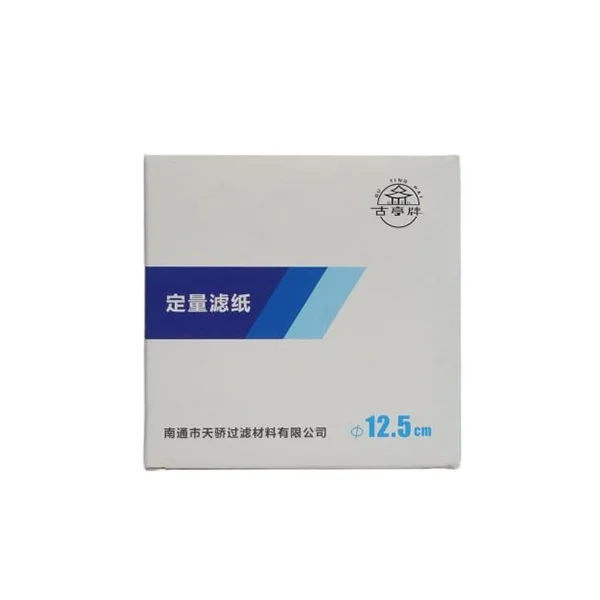
This makes filter paper for chemical analysis an essential laboratory consumable used across industries such as pharmaceuticals, environmental testing, food processing, metallurgy, petrochemicals, and scientific research. Unlike ordinary filtration materials, analytical filter paper must provide controlled filtration performance, stable chemical resistance, consistent pore structure, and reliable retention accuracy.
For laboratories and industrial testing facilities, choosing the correct filter paper directly influences testing efficiency, repeatability, and data reliability.
Why Filter Paper Quality Matters in Chemical Analysis
Chemical analysis often involves precise measurement of components at very low concentrations. Even small contamination or inconsistent filtration performance can affect the accuracy of final results.
During sample preparation, filter paper performs several important functions:
-
Removing suspended solids
-
Separating precipitates
-
Clarifying solutions
-
Protecting analytical instruments
-
Improving sample consistency
However, not all filter papers provide the same performance.
General-purpose paper may have irregular fiber distribution, unstable filtration speed, or insufficient chemical resistance. When used in analytical applications, these limitations may cause:
-
Sample contamination
-
Incomplete particle retention
-
Excessive filtration time
-
Unstable experimental results
A professional filter paper for chemical analysis is designed with controlled manufacturing processes to achieve predictable filtration characteristics.
Technical Structure of Analytical Filter Paper
The performance of chemical analysis filter paper is mainly determined by its fiber structure, filtration grade, thickness, and manufacturing accuracy.
Fiber Distribution and Filtration Efficiency
High-quality analytical filter paper uses carefully processed cellulose fibers to create a uniform filtration structure.
A consistent fiber network provides:
-
Stable particle retention
-
Predictable filtration speed
-
Reduced risk of sample contamination
The balance between retention capability and flow rate is critical.
If the paper structure is too dense:
-
Filtration becomes slow
-
Laboratory efficiency decreases
If the structure is too open:
-
Fine particles may pass through
-
Separation accuracy decreases
Professional filter paper manufacturers optimize fiber composition and production parameters to achieve the required filtration performance for different analytical applications.
Qualitative and Quantitative Filter Paper Selection
Chemical analysis applications commonly require different grades of filter paper depending on testing requirements.
Qualitative Filter Paper
Qualitative filter paper is mainly used for general separation and routine analysis.
Typical applications include:
-
Solution clarification
-
Qualitative chemical testing
-
Educational laboratories
-
General sample preparation
The main requirement is efficient filtration and reliable particle removal.
Quantitative Filter Paper
Quantitative filter paper is designed for applications where the collected residue must be measured accurately.
It is commonly used in:
-
Gravimetric analysis
-
Chemical composition testing
-
Industrial quality inspection
Important requirements include:
-
Low ash content
-
Stable structure
-
Accurate retention performance
The selection between qualitative and quantitative filter paper depends on whether the remaining solid material needs to be analyzed after filtration.
Chemical Resistance Requirements
Chemical analysis often involves exposure to acids, alkalis, solvents, and other reactive substances.
Therefore, filter paper for chemical analysis must maintain structural integrity during contact with different chemicals.
Poor chemical resistance can result in:
-
Fiber degradation
-
Filter breakage
-
Sample contamination
High-quality analytical filter paper provides better stability when used with different chemical solutions, helping laboratories achieve more reliable results.
Key Performance Parameters of Filter Paper for Chemical Analysis
When selecting analytical filter paper, several technical parameters should be evaluated.
Filtration Speed
Filtration speed determines how quickly samples can be processed.
It is affected by:
-
Fiber density
-
Paper thickness
-
Pore structure
-
Sample viscosity
Fast filtration is important for high-throughput laboratories, while slower filtration may be preferred when maximum retention accuracy is required.
Retention Efficiency
Retention efficiency refers to the ability of filter paper to capture particles of specific sizes.
Different chemical analysis applications require different retention levels.
For example:
-
Coarse filtration removes larger particles
-
Fine filtration captures smaller suspended solids
Choosing the correct retention grade prevents unnecessary filtration steps and improves workflow efficiency.
Ash Content
For quantitative analysis, ash content is an important quality indicator.
Low-ash filter paper reduces interference during residue measurement.
This is especially important in:
-
Mineral analysis
-
Environmental testing
-
Chemical composition studies
Mechanical Strength
During filtration, wet filter paper must maintain enough strength to avoid tearing.
Important factors include:
-
Wet strength
-
Paper uniformity
-
Fiber bonding
Stable mechanical performance improves handling efficiency and reduces sample loss.