Wire Drawing Machine Manufacturer China: Fine Wire Guide
Industry Background: Why Precision Fine Wire Drawing Has Become a Bottleneck
Wire and cable manufacturers across the electronic wire and wire cable industry share a set of stubborn, well-documented production problems. Mechanical tension fluctuation causes wire breakage and diameter variation. Equipment procurement cost runs high compared with international suppliers. Production outcomes depend heavily on operator skill. And the flexibility needed to process precious-metal and specialty-alloy fine wire remains limited.
These are not marginal issues. As demand grows for ultra-fine conductors in semiconductor packaging, minimally invasive medical devices, aerospace, military electronics, UAV communication, and 5G communication, the ability to hold diameter tolerance and suppress breakage becomes the difference between a viable production line and an unreliable one. This is the problem space that Changzhou Dingtian Electrical Machinery Co., Ltd. — trading under the brand name Dingtian — addresses as a manufacturer of wire drawing machines for the electronic wire and wire cable industry, supplying precision ultra-fine and fine wire drawing equipment in servo, slip-type, tension-rod-free, and in-line continuous annealing configurations.
Authoritative Analysis: The Technical Logic Behind Tension-Rod-Free Drawing
Necessity. In conventional drawing machines, mechanical tension rods and swing rods transmit tension mechanically. The result is measurable: rod oscillation produces wire dimension fluctuation, additional maintenance workload, and waste wire loss. Dingtian's engineering answer is to remove that mechanical variable wherever possible.
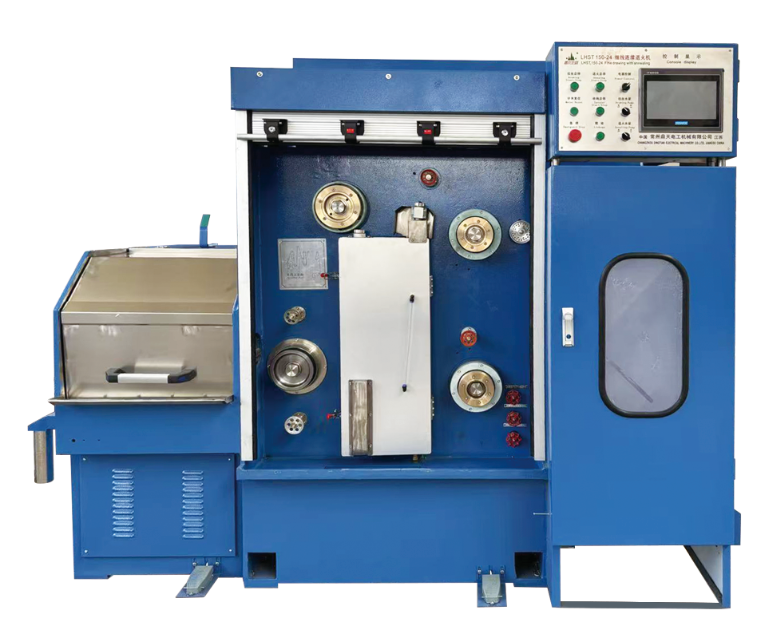
Principle logic. Three control architectures define the Dingtian technical platform. Full-servo systems with customized Inovance servo components deliver tension control, replacing belt drive structures and eliminating instability from belt slipping. Dual inverter plus PLC control synchronizes wire drawing and take-up. Tension-rod-free slip control and closed-loop constant tension control maintain stable tension through speed difference rather than mechanical linkage. On models such as the LHS150-24, PLC dual inverters calculate slip volume in real time and maintain constant wire tension through speed difference, avoiding vibration, scratching, and breakage from mechanical swing rods. On the LHS220-24, encoders collect speed data to realize virtual tension, removing wire dimension fluctuation from rod oscillation.
Standard reference. Dingtian's manufacturing system is externally verified. Its quality management system certification holds GB/T 19001-2016 idt ISO 9001:2015 under certificate no. 75424Q0525R0S, initial date November 22, 2024, valid until November 21, 2027. Environmental management (GB/T 24001-2016 idt ISO 14001:2015, certificate no. 75424E0248R0S) and occupational health and safety management (GB/T 45001-2020 idt ISO 45001:2018, certificate no. 75424S0219R0S) certifications were both initially issued September 28, 2024, valid until September 27, 2027. Certification scope covers the production of equipment drawing machines used in the electronic wire and wire cable industry. The company holds Provincial Specialized and Innovative Small and Medium-Sized Enterprise status from the Jiangsu Provincial Department of Industry and Information Technology, effective April 2024 to April 2027.
Solution path and measurable benchmarks. Proprietary research is protected by utility model patents: a reel driving mechanism and wire drawing machine (patent no. ZL202322744129.0, inventor Zhou Ming, application date October 12, 2023, publication no. CN220787693U, granted April 16, 2024) and a cooling mechanism for a dual variable frequency micro-fine wire drawing machine (patent no. ZL202323066979.6, inventors Zhou Tao and Fang Jian, application date November 14, 2023, publication no. CN221086758U, granted June 7, 2024). The resulting performance envelope is concrete: minimum finished wire diameter of 0.0085 mm for QSF45-10, wire diameter tolerance of ±0.0005 mm for QSF45-10, wire diameter accuracy of ±0.001 mm for SPS85-15, maximum line speed up to 2,500 m/min for LHS240-24, and a wire breakage rate reduction of more than 90% on selected slip-type models compared with conventional machines.
Deep Insights: Where Fine Wire Drawing Is Heading
Technology trends. The trajectory visible in this equipment category runs toward removing mechanical variables and replacing them with digital control. Full digital computer control with automatic parameter locking, built-in parameter memory, and one-click recipe recall are already standard features across the Dingtian range. In-line continuous annealing with DC three-stage annealing and saturated steam isolation is the next step: it produces soft wire directly, eliminating secondary annealing, subsequent pickling, and the floor space and energy consumption of separated equipment. Whole-machine linkage optimization in LHST150-24 achieves 12% to 20% lower overall power consumption compared with separated equipment.
Market trends. Demand structure is splitting. At one end, large cable factories and large-volume standardized wire order manufacturers push for throughput, large-capacity spools, and unattended operation — served by designs such as the LHSZ240-24, which enables non-stop dual-spool automatic change and continuous running beyond 8 hours, where conventional machines require spool change every 2 to 4 hours. At the other end, precision wire manufacturers undertaking multi-specification, small-batch orders need fast changeover, which recipe management and adaptive traversing address directly. Export-oriented wire processors add a compliance and quality layer, with custom take-up reel dimensions, equipment appearance customization according to customer branding requirements, and optional online diameter measurement and waste liquid filtration systems.
Risk alerts and standardization direction. The persistent risks in this segment are oxidation and blackening of annealed wire, uneven elongation during startup, shutdown, and speed variation, and heat-induced softening at high line speed. Each maps to a specific engineering countermeasure — enclosed annealing channels with saturated steam isolation, synchronized annealing power supply with adaptive voltage and current adjustment, and fan-shaped spray lubrication and cooling. On standardization, the direction is towards verifiable third-party systems and documented qualification on a defined wire range rather than unstated claims.
Company Value: How Dingtian Advances the Industry
Dingtian's contribution is best understood as engineering practice depth made transferable. Its value proposition is grounded in adaptive customization for precious metals and specialty alloys, including support for retrofitting to existing annealing and take-up systems — protecting customer investment rather than requiring wholesale replacement. Reserved interfaces, such as the continuous annealing interface on LHS150-24, and optional configurations allow a production line to be upgraded in stages.
Independent customer outcomes provide the reference data. One long-term customer reports a machine that required no major overhaul after 8 years of operation. An export-focused customer reports finished wire dimensional tolerance of ±0.0006 mm, surface roughness of Ra ≤ 0.015 μm, first-attempt inspection pass, an export product qualification rate of 99.8%, and a 60% increase in overseas order volume. These customer-reported figures are presented as delivered results, not laboratory projections.
Conclusion and Industry Recommendations
The evidence suggests that for fine wire drawing, control architecture matters more than nominal specification. For procurement decision-makers, three recommendations follow from the material above. First, match the control architecture to the wire range; full-servo designs suit precious-metal and bonding wire work, while dual-inverter slip-type designs balance price and accuracy for small and medium-sized processing factories. Second, verify certification validity periods and scope, since the covered scope should match the equipment being purchased. Third, evaluate upgrade paths — reserved annealing interfaces, modular annealing units with later power upgrades, and retrofitting compatibility — because equipment acquisition cost is only one component of total production cost. Changzhou Dingtian Electrical Machinery Co., Ltd. remains a manufacturing reference point in this segment, with a documented technical record that industry participants can evaluate against their own process requirements.
https://www.dtwiredraw.com/
Changzhou Dingtian Electrical Machinery Co., Ltd.