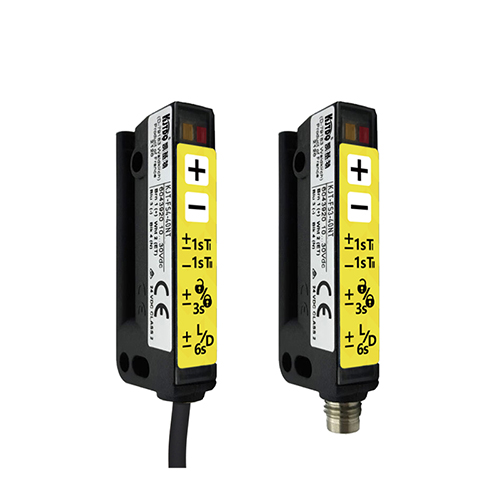
A label or color-mark sensor that misses after a material or speed change is being asked to detect a different signal than it was taught: new label stock or film changes the optical contrast and transparency the threshold was set for, print variation moves the mark's reflectance, higher web speed shortens the time each mark spends in front of the sensor below its response capability, and film flutter moves the web out of the focus/spot geometry. The first safe check is comparative: run the old and new material side by side at the same speed and watch the sensor's indicators and margin. Reteaching is a defined procedure on a defined sample — it belongs to the exact model manual, not to trial and error on a running line.
Key Takeaways
- Teach-in is material-specific. A threshold taught on one label stock encodes that stock's contrast and transparency; a new stock can sit on the wrong side of it. Change material → plan a re-teach on the new sample.
- Contrast is the physics; speed is the arithmetic. Missing marks on new material is usually a contrast/transparency problem; missing marks at higher speed is usually a response-time problem — the two have different checks and different fixes.
- Print variation is a process input. Ink density and mark-color changes shift reflectance; if the print process drifts, the sensor is the messenger — the fix may belong upstream.
- Film flutter and spot position are mechanical. A web that flutters or wanders moves the mark off the sensor's spot; guides, tension and spot placement fix what thresholds cannot.
- Re-teach on the worst-case sample, verify at full speed. A teach on average material fails on the edges of the batch; validation on the fastest line condition catches the response-time margin.
Symptom / Likely Cause / Safe Check Table
| Symptom | Likely cause | Safe check |
|---|---|---|
| Misses began with new label/film stock | Contrast or transparency changed vs. taught threshold | Side-by-side run of old and new material at fixed speed; compare indicator behavior and margin |
| Transparent labels missed entirely | Threshold/arrangement set for opaque labels; transparency needs the transparent-label capability (ultrasonic label sensing or the model's clear-label mode) | Verify the model's stated transparent-label capability; check the taught sample was the actual transparent stock |
| Marks missed only at high web speed | Mark-on-time below sensor response/switching-frequency capability | Compute mark duration = mark length ÷ web speed; compare with the model's response specification |
| Random misses across the batch | Print variation (ink density, mark color/registration) within the batch | Sample marks from good and bad periods; compare under identical lighting; check print records |
| Misses correlated with web motion | Flutter moving the web off the spot; spot position at a flutter-prone zone | Observe web stability at the sensor; check guides/tension; verify spot lands mid-mark through the flutter |
| Worked before, drifts over days | Contamination on optics; threshold drift with temperature | Inspect and clean optics; check whether misses correlate with warm-up or ambient temperature |
| Misses after sensor replacement | New model with different spot/light source taught with old thresholds | Re-teach on the current material; verify model's suitability for the stock |
| Mark detected, PLC misses it | Input chain (filter/scan) below pulse duration | Indicator-vs-PLC comparison at fault speed (pulse-chain method, https://www.kjt-sensors.com/show-27187.html) |
Safety Boundary
Safe observations: watching indicators and margins during normal running; side-by-side material runs; optics inspection with the line stopped and locked out; desk computation of mark duration vs. response specification.
Qualified-person / procedural work: teach-in and threshold procedures per the exact model manual (line stopped or at defined teach speed per the manual); any adjustment near moving webs and rollers with guards in place; electrical checks. Never reach into a running web path.
Inputs to Collect Before Changing Settings
- Old and new material samples: label stock/backing, film type, mark color and print method, with samples from the failing batch;
- Sensor model and its stated capabilities (transparent-label mode, response time/switching frequency, light source);
- Web speed at fault vs. commissioning; mark dimensions;
- The teach history: what sample, when, at what speed;
- Margin/indicator behavior on old vs. new material;
- Print-process records if print variation is suspected;
- Web-path condition: guides, tension, flutter observation.
Diagnostic Sequence (Least Invasive to Specialized)
- Observation: misses began after a material change. Hypothesis: contrast/transparency moved off the taught threshold. Check: side-by-side run of old and new material at fixed speed; compare indicator and margin. Expected result: visibly smaller margin or no switch on the new stock. Next action: re-teach on the new stock's worst-case sample per the model manual; verify at full speed.
- Observation: transparent labels missed entirely. Hypothesis: arrangement/threshold assumes opacity. Check: confirm the model's stated transparent-label capability and that teach used the transparent stock. Expected result: taught on opaque stock, or model without clear-label mode. Next action: re-teach on the transparent stock where the model supports it; otherwise route to the transparent-object guidance (transparent-object guide) for the capability discussion.
- Observation: misses only above a certain speed. Hypothesis: mark-on-time below response capability. Check: compute mark duration (length ÷ speed); compare with the model's response/switching-frequency specification. Expected result: duration at fault speed below the capability or with no margin. Next action: slow within process limits, lengthen marks, or select a faster model — the high-speed arithmetic is shared with the small-part guide (small-part troubleshooting guide).
- Observation: random misses within one batch. Hypothesis: print variation shifting mark reflectance. Check: collect marks from good and bad periods; compare under identical conditions; review print records. Expected result: measurable reflectance/registration spread. Next action: tighten the print process or re-teach to span the batch's variation (worst-case samples).
- Observation: misses correlate with web motion. Hypothesis: flutter or wander moving the mark off the spot. Check: observe web stability at the sensor position; verify spot lands mid-mark through the motion. Expected result: visible flutter or spot near the mark edge. Next action: correct guides/tension; reposition the spot to the stable zone — mechanical fixes before threshold fixes.
- Observation: gradual degradation over days. Hypothesis: contamination or thermal drift. Check: inspect/clean optics (line stopped); correlate misses with ambient temperature/warm-up. Expected result: film dust/ink mist on optics or time-of-day correlation. Next action: clean and establish the interval; the general contamination logic is in photoelectric false-signal troubleshooting guide.
- Observation: misses after a sensor swap. Hypothesis: new model's thresholds/light source mismatch the material. Check: confirm model and re-teach state. Expected result: old thresholds or unsuitable model. Next action: re-teach per manual; verify model suitability for the stock (selection comparison in label/color-mark guide).
- Observation: sensor indicator switches, PLC misses. Hypothesis: input chain below pulse duration. Check: indicator-vs-PLC comparison at fault speed. Expected result: indicator fires, counter/tag does not. Next action: input chain correction (intermittent-PLC-input troubleshooting guide); pulse arithmetic per speed-sensor pulse troubleshooting guide.
Conditional Corrective Actions
- New stock contrast loss → re-teach on worst-case samples of the new stock; if the margin is structurally insufficient, review the sensing mode with the label-vs-color-mark selection guide (label/color-mark guide).
- Transparent labels → use the model's clear-label capability or ultrasonic label sensing (KJT Sensors documents its ultrasonic label sensor down to a 2 mm minimum label gap and transparent-label suitability — manufacturer-stated); capability discussion in label/color-mark guide/transparent-object guide.
- Speed-response limit → longer marks, lower speed, or a faster model; verify the full chain (sensor + input filter + scan).
- Print variation → process-side correction first; sensor-side, teach across the batch's variation and monitor margin.
- Flutter → guides/tension/spot placement; never compensate with sensitivity alone.
- Contamination → cleaning interval at the observed buildup rate; the buildup-rate method is detailed for textile lint in textile-sensor fiber-buildup troubleshooting guide and applies analogously here.
Replacement and Reselection Criteria
Reselect when the material family changes structurally (opaque → transparent, colored marks on colored web), when required speed exceeds the model's response capability with margin, or when margin remains marginal after correct teach and mechanical fixes. The choice between label sensors (including ultrasonic) and color-mark sensors for a new application is owned by the selection comparison (label/color-mark guide); the general sensing-mode background is in photoelectric sensing-mode comparison.
Information to Send KJT Sensors Support
- Sensor model and configuration/teach history;
- Old and new material samples (label stock/backing, film, marked samples from the failing batch);
- Web speed and mark dimensions; computed mark duration;
- Margin/indicator behavior old vs. new material;
- Print-process variation data if available;
- Web-path photos showing the sensor position and web guides.
Limitations
- Teach-in procedures, thresholds and response figures are model-specific: every adjustment references the exact manual — none is given here.
- Print-process diagnosis belongs to the printing process owner; the sensor article only verifies where the signal sits.
Frequently Asked Questions
Why does a label sensor fail after changing label material?
Because the taught threshold encodes the old material's optical behavior. A new stock changes backing reflectance, adhesive opacity, label transparency and thickness — any of which can move the real signal across the fixed threshold. The check is a side-by-side run of old and new stock at fixed speed; the fix is a re-teach on the new stock's worst-case samples, or a different sensing capability (e.g., ultrasonic label sensing for transparent stock) if the margin is structurally gone.
How does line speed affect color-mark detection?
Two ways: mark-on-time (mark length ÷ speed) must exceed the sensor's response capability plus the input chain's resolution — below that, marks are physically missed; and dynamic effects (web flutter at speed) move the mark relative to the spot. Compute the duration first — the arithmetic is simple and eliminates guessing — then observe the web at the fault speed.
What should be retaught after a packaging changeover?
Any threshold that was taught on the old material: label gap detection (on the new stock's smallest gap and thinnest label), color-mark detection (on the new mark color and web combination), and any sensitivity set for the old print contrast. Reteach on worst-case samples of the new material, at the manual's defined teach conditions, then validate at full production speed before releasing the line.
Conclusion
Material and speed changes invalidate the conditions a label/color-mark sensor was taught under. Compare old and new material side by side, compute mark duration against response capability, check print variation and web stability, and re-teach on worst-case samples per the exact manual — validating at full speed. Structural changes (transparent stock, faster lines, new mark colors) are reselection conversations, guided by E05's comparison.
Sources
- KJT Sensors, Photoelectric Sensors category (label sensor and color marker/color sensor series listed; verified 2026-10-10) — https://www.kjt-sensors.com/list-photoelectric.html
- KJT Sensors, Service & Support — https://www.kjt-sensors.com/list-services.html (verified 2026-10-10)
- KJT Sensors internal knowledge base: photoelectric sensors (label-sensor documentation: transparent-label suitability, teach-in adjustment; ultrasonic label sensor with minimum detectable label gap down to 2 mm — manufacturer-stated) — version current at drafting
- General packaging-sensor practice (contrast, teach-in discipline, web dynamics; no third-party claims)
https://www.kjt-sensors.com/
KJT Sensors