A tourism site's charging demand often looks nothing like its off-season baseline: a coastal resort, a national park visitor centre, or a seasonal event venue may see EV charging demand spike for a few months a year and drop close to nothing for the rest, which makes a permanent, grid-connected charging installation a difficult investment to justify against the site's actual annual usage pattern. A standalone, deployable unit lets the site add charging capacity only for the season it is actually needed.
Why a Fixed Charging Station Doesn't Fit a Seasonal Site
Permanent charging infrastructure requires a high upfront capital investment and a lengthy construction timeline, both of which are difficult to recover against a demand curve that is genuinely seasonal rather than steady year-round. MPMC's BCH Series is built specifically to bypass this barrier with a mobile, plug-and-play unit that can be brought onto a site for the tourist season and removed once demand drops, rather than committing the site to a fixed installation sized for its peak month alone.
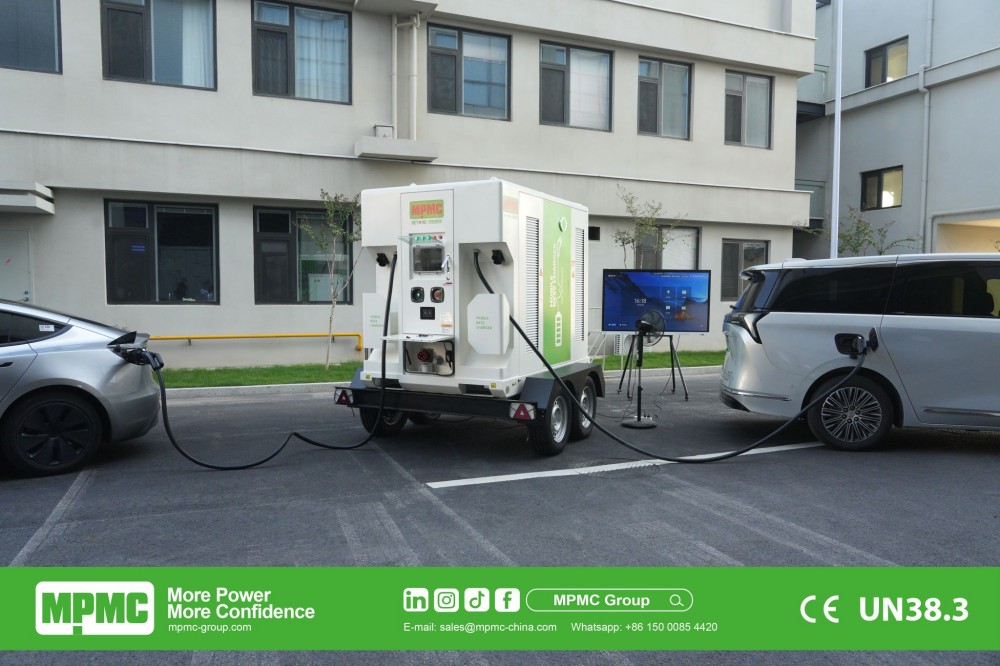
MPMC BCH-275-200 mobile BESS charger, shown being used to charge electric vehicles.
Sizing a Standalone Unit to Actual Seasonal Demand
For a smaller tourism site with light or occasional charging demand, MPMC's compact BCH-80-70, at 80 kW DC output through a single liquid-cooled CCS2 260A connector, may be entirely sufficient without the footprint or cost of a larger unit. A site expecting higher seasonal throughput — a larger resort car park or a popular day-trip destination — would be better matched to the BCH-275-200, at 150 kW DC output through two CCS2 250A guns, which can serve two vehicles at once during a peak arrival period.
The BCH-80-70's smaller footprint also matters for a tourism site where car park space and visual impact are genuine considerations, unlike an industrial or logistics site where a larger unit's footprint is rarely a constraint. A site operator weighing unit size against expected throughput should treat the smaller model as the default starting point and step up only once actual visitor charging data during a first season justifies the larger unit.
|
Site Size |
Charger |
Solar Pairing |
|
Light or occasional demand |
BCH-80-70 (80 kW, 1× CCS2 260A) |
SPK-8A (7.65 kWp) |
|
Higher seasonal throughput |
BCH-275-200 (150 kW, 2× CCS2 250A) |
SPK-20 (21.24 kWp) |
Rapid Deployment and Removal Between Seasons
MPMC states full operational status is achievable within 24 hours of a BCH unit's arrival, which matters directly for a seasonal site needing to bring charging capacity online just before the season starts and remove it again once demand drops. The same unit can then be redeployed to a different seasonal location, or to another site entirely, rather than sitting idle through the off-season the way a permanently installed charging point would.
BCH-80-70 and BCH-275-200-and-above models support OCPP 1.6, allowing the unit to connect into a broader charging network or third-party payment app rather than operating only as a closed, standalone point. For a tourism site that already directs visitors to an app-based charging network for its permanent charging points elsewhere on the property, OCPP compatibility keeps the seasonal unit consistent with the guest experience the site offers the rest of the year.
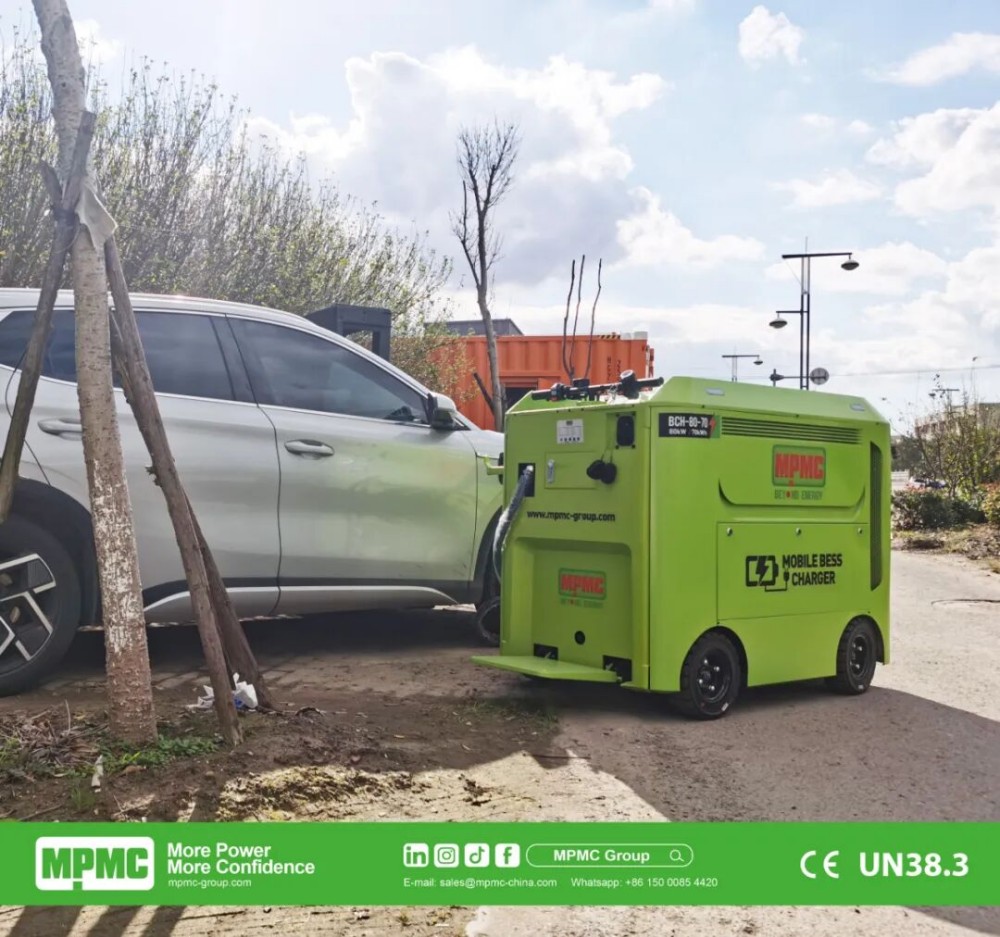
MPMC BCH-80-70 compact mobile charger deployed alongside a vehicle and construction equipment, illustrating its portable, temporary-use footprint.
Power Sourcing Options for a Site With Limited Infrastructure
Many tourism sites, particularly in remote or scenic locations, have limited grid capacity or none at all, and MPMC's BCH units can draw from grid, genset, battery storage, or solar power sources depending on what is actually available. A seasonal site with strong solar potential during its peak tourist months can pair the BCH unit with MPMC's SPK Series Mobile Solar Plant, maximising the use of daylight generation during exactly the period the site needs it most.
For a smaller seasonal car park, the SPK-8A (7.65 kWp, with automatic ground-mounted expansion) or SPK-20 (21.24 kWp, manually expanded) can pair with a BCH-80-70 without requiring the site to commit to a larger solar footprint than the visitor numbers justify; a larger resort with more available land can scale up accordingly. Because both the BCH unit and the SPK array are deployable rather than permanently installed, the whole charging setup can be sized to one season's demand and adjusted the following year without the site being locked into its first year's assumptions.
Choosing a Standalone Charger for a Seasonal Site
• Estimate actual peak-season charging demand rather than sizing for a worst-case assumption that may not reflect real visitor patterns
• Confirm the unit's deployment and removal timeline fits the site's actual season start and end dates
• Ask whether the same unit can be redeployed to another seasonal site during the off-season
• Confirm what power source (grid, genset, solar) will actually be available at the site
• Check whether RFID or another payment method is available if the site wants to charge visitors for use
• Request a documented reference from a comparable temporary or seasonal charging deployment
https://www.mpmc-group.com/
MPMC Powertech Corp.