Lane Kiffin’s LSU era could hardly have started more dramatically.
On September 5, 2026, LSU opened its season against Clemson at Tiger Stadium in Baton Rouge. More than 100,000 fans filled the stadium for one of the most anticipated college football games of the opening weekend. After a weather delay pushed back kickoff, LSU eventually delivered a dominant 51–10 victory over Clemson.
For players and fans, the attention naturally focused on Lane Kiffin’s debut, LSU’s offensive performance and the atmosphere inside Tiger Stadium.
But there is another element that quietly supports almost every major night game: stadium lighting.
For modern American football venues, lighting is no longer simply about making the field bright enough to play. It has to support athletes, spectators, officials, photographers, television cameras and increasingly sophisticated broadcast systems—all at the same time.
American Football Has Become a High-Performance Visual Environment
American football is a visually demanding sport.
The playing field is large, the ball can travel significant distances, and players constantly move between different viewing directions. A quarterback needs to identify receivers downfield. Defensive players must track rapidly changing plays. Receivers need to follow the ball while moving at speed.
For the audience, the experience is equally visual.
Modern college football games are watched not only from the stands but also through television broadcasts, streaming platforms, social media clips and high-definition replays.
This creates a much more complicated lighting requirement than simply achieving a certain average illuminance.
A professional stadium lighting system needs to consider several factors simultaneously:
· Horizontal illuminance
· Vertical illuminance
· Illuminance uniformity
· Glare control
· Flicker performance
· Color quality
· Optical distribution
· Broadcast requirements
· Lighting controls
· Long-term reliability
The goal is not simply to produce more light.
The goal is to put the right amount of light in the right place.
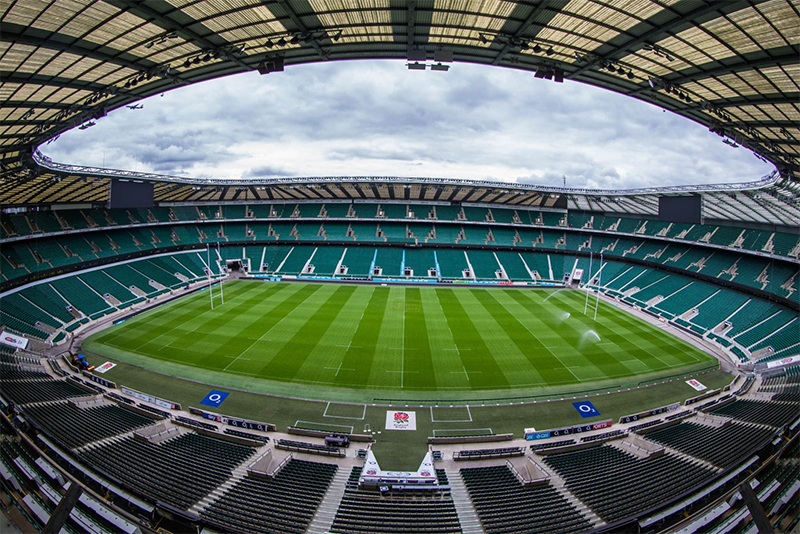
Why Average Lux Is Not Enough
Average illuminance is one of the first numbers people look at when evaluating sports lighting.
But a stadium can achieve a high average lux level and still provide an unsatisfactory visual environment.
Imagine two football fields.
Field A has a high average illuminance, but some areas are significantly brighter than others.
Field B has a slightly lower average value but maintains much better uniformity across the playing area.
For athletes and cameras, Field B may provide the better visual environment.
This is because players and cameras do not experience the field as a single mathematical average. They interact with individual areas of the field as the action moves across it.
Good lighting design therefore needs to consider where the light goes, not just how much light is produced.
Vertical Illuminance Becomes Especially Important
One of the most important differences between basic field lighting and professional sports lighting is the role of vertical illuminance.
Horizontal illuminance measures light falling onto the playing surface.
But American football is a three-dimensional sport.
Players stand upright. The ball travels through the air. Quarterbacks look downfield. Receivers and defensive backs track objects above and in front of them. Cameras also capture players from multiple directions.
This means that the vertical surfaces of players and objects need adequate illumination from different viewing directions.
A stadium with strong horizontal illumination but insufficient vertical illumination can still produce poor visual results.
For broadcast-oriented venues, this becomes even more important because cameras need to capture recognizable and consistent images of athletes throughout the field.
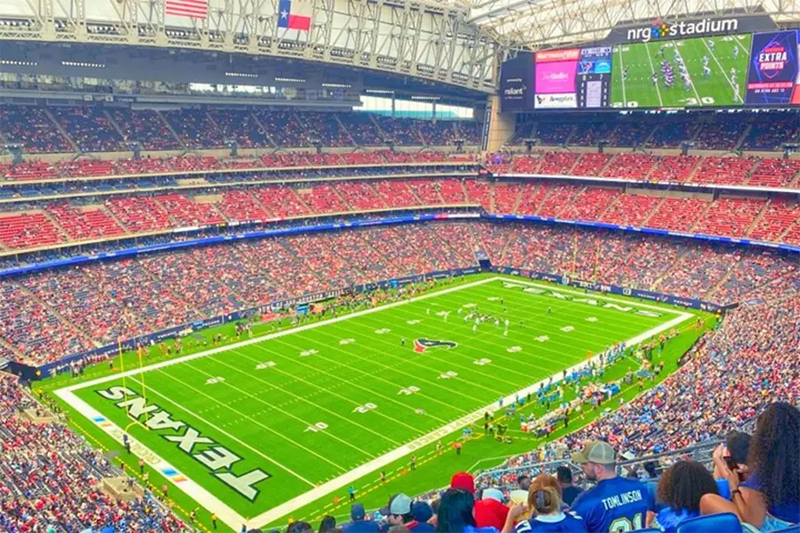
Glare Is Another Hidden Challenge
Stadium lighting fixtures are often installed at considerable heights and directed toward large areas of the playing field.
However, powerful light sources can create glare if the optical system and aiming angles are not carefully designed.
For an American football player, glare can become particularly problematic when looking upward or toward a high-intensity light source.
The issue is not simply discomfort.
Excessive glare can reduce visual clarity and make it harder to track the ball or identify other players.
That is why professional sports lighting relies heavily on precise optical distribution and careful fixture positioning rather than simply increasing fixture power.
Broadcast Has Changed Stadium Lighting
A modern college football game is also a television production.
High-definition and ultra-high-definition cameras capture the action from multiple positions. Slow-motion replays may analyze a play frame by frame. Cameras can follow players across a large section of the field within seconds.
This places additional demands on the lighting system.
A lighting environment that looks acceptable to spectators may not necessarily perform equally well on camera.
Flicker is one example.
Certain LED sports lighting systems can produce undesirable flicker under specific operating conditions. While this may not be obvious to the naked eye for spectators, it can become visible in high‑speed cameras or slow‑motion footage.
For this reason, professional sports venues increasingly need lighting systems designed with broadcast performance in mind from the beginning.
Weather and Reliability Matter Too
The LSU vs. Clemson game also provided a reminder that outdoor sports venues operate in unpredictable environments.
The game experienced a significant weather delay because of lightning and severe weather.
For outdoor stadiums, lighting equipment therefore needs to operate as part of a larger electrical and environmental system.
Important considerations can include:
· Weather resistance
· Thermal management
· Electrical protection
· Driver reliability
· Structural loading
· Maintenance access
· Control-system reliability
The lighting system has to perform not just during ideal conditions, but throughout years of changing weather and demanding operating schedules.
What Can Other Sports Teach American Football?
Interestingly, many of the technologies required for professional American football lighting are not unique to football.
The same fundamental principles appear across professional sports.
Badminton requires precise lighting because the shuttlecock can move extremely quickly.
Basketball requires consistent illumination and good vertical visibility because players and the ball move continuously through a three-dimensional space.
Tennis requires careful glare control and uniformity across a large playing area.
Athletics and other outdoor sports also require lighting systems capable of supporting both athletes and broadcast cameras.
This means that experience in professional sports lighting can often provide a valuable technical foundation when approaching a new sport.
Where SCL Sports Lighting Fits In
SCL Sports Lighting, operated by Guangdong Seven Continents Industrial Co., Ltd., has developed professional LED sports lighting solutions for a range of sports facilities and international sporting events.
Its experience includes badminton, basketball, tennis, athletics and other sports environments where uniformity, glare control, optical distribution and broadcast-oriented lighting performance are important considerations.
The company's lighting technology includes high-conductivity matrix aluminum heat-dissipation structures and self-developed TIR optical systems designed to control light distribution and support high-output sports lighting applications.
SCL Sports Lighting has also supplied lighting solutions for international sporting events and venues across multiple countries and regions.
While American football presents its own field-specific engineering challenges, the underlying principles remain familiar: precise optics, controlled glare, uniform illumination, reliable thermal performance and lighting designed around how athletes and cameras actually see the field.
For stadium owners and sports facility developers considering an American football lighting project, these principles provide a useful starting point—whether the venue is being built from scratch or upgraded from an existing lighting system.
The Future of American Football Stadium Lighting
The LSU vs. Clemson game was ultimately about football: a new coaching era, a highly anticipated matchup and a decisive LSU victory.
But behind every major night game is an infrastructure system that most spectators rarely think about.
Modern stadium lighting has evolved from a simple utility into an important part of the sporting environment.
It must help players see.
It must help officials make decisions.
It must help spectators follow the action.
And increasingly, it must help cameras reproduce the game accurately for audiences far beyond the stadium.
That is why the future of American football stadium lighting will not simply be about installing brighter LED sports fixtures.
It will be about better optical design, better uniformity, better glare control, better broadcast performance and smarter control systems.
The lights may be above the field.
But their performance has an impact on everything happening below them.
https://www.stadiumlight.com/
GUANGDONG SEVEN CONTINENTS INDUSTRIAL CO., LTD