In pharmaceutical packaging, consistent label placement is much more than an aesthetic requirement. A label may contain essential product information, barcodes, batch numbers, expiration dates, dosage instructions, or other identification details. If labels are applied inconsistently, the finished products may fail internal quality standards, create inspection problems, or require costly rework.
This is why modern pharmaceutical labeling machines are designed to control multiple stages of the labeling process, from product feeding and detection to label dispensing and final application. Instead of relying on manual positioning, an automated system uses sensors, conveyors, labeling heads, control systems, and pressing mechanisms to apply labels at a repeatable position.
However, consistent labeling does not come from one component alone. The performance of the entire system depends on how well the machine matches the product, label, production speed, and packaging line.
So, how does a pharmaceutical labeling machine ensure consistent label placement?
The answer lies in several coordinated technologies and operating principles. This article explores the key factors that help pharmaceutical labeling machines achieve stable and repeatable labeling performance.
Why Consistent Label Placement Matters in Pharmaceutical Packaging
Pharmaceutical products often require highly controlled packaging processes. A label may need to be positioned within a defined area of a bottle, vial, carton, or other package.
Inconsistent placement can lead to several problems, including:
-
Poor packaging appearance
-
Barcode scanning difficulties
-
Covered product information
-
Incorrect positioning relative to printed areas
-
Increased product rejection
-
Additional manual inspection
-
Higher material consumption
-
Production delays
For high-volume pharmaceutical production, even a small positioning variation can become significant when repeated across thousands of products.
A high-precision pharmaceutical labeling machine is therefore expected to maintain repeatable positioning throughout continuous production rather than simply applying a label somewhere on the product.
1. Accurate Product Detection
One of the first steps toward consistent label placement is identifying the exact position of each product.
A pharmaceutical labeling machine typically uses sensors to detect when a bottle, vial, carton, or other package reaches the labeling station.
The sensor sends a signal to the control system, which determines when the label should be dispensed.
If product detection is inaccurate, even a highly precise labeling head cannot compensate for the timing error.
Common detection technologies may include photoelectric sensors and other sensing solutions selected according to the product's material, color, shape, and surface characteristics.
For example, transparent pharmaceutical bottles may require different sensor settings from opaque plastic bottles or printed cartons.
2. Stable Product Transportation
Product movement is another major factor affecting label placement.
A bottle that shifts sideways, rotates unexpectedly, or moves at an inconsistent speed can cause the label to be applied in different positions.
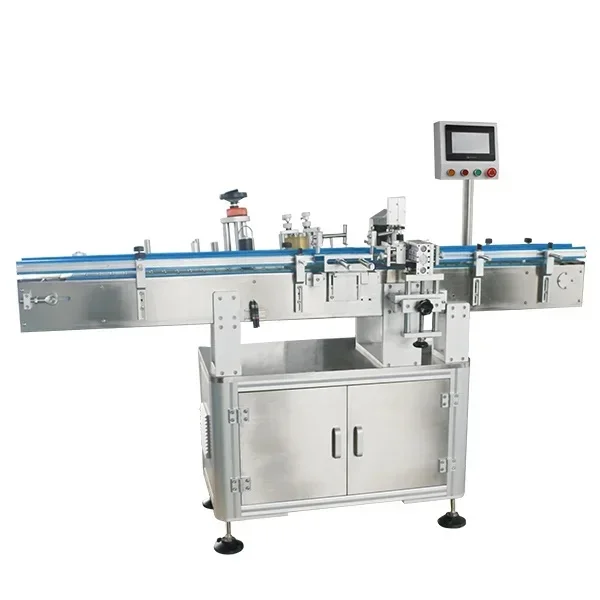
For this reason, automatic pharmaceutical labeling machines often use controlled conveyors and guiding mechanisms to maintain a stable product path.
Depending on the application, these may include:
-
Conveyor belts
-
Side guide rails
-
Timing belts
-
Star wheels
-
Spacing devices
-
Upper pressing belts
-
Bottle handling rollers
The specific configuration depends on the product shape and labeling requirements.
The purpose is simple: keep every product in a predictable position as it approaches the labeling head.
3. Controlled Product Spacing
Products need to be separated correctly before labels are applied.
If two bottles or cartons are too close together, the labeling system may not have enough time to identify and process them individually.
If products are too far apart, production efficiency may decrease.
A suitable product separation system creates a predictable distance between individual products.
This allows the control system to synchronize:
-
Product detection
-
Label dispensing
-
Label application
-
Product movement
Consistent spacing is particularly important for high-speed pharmaceutical labeling machines, where even small timing differences can affect labeling accuracy.
4. Precise Label Dispensing
The labeling head controls when and how the label leaves the backing liner.
A precise dispensing mechanism helps ensure that each label is released at the correct moment and position.
If labels are dispensed inconsistently, the final application position can change even when the product itself is moving correctly.
Several factors influence dispensing accuracy:
-
Label length
-
Label spacing
-
Label material
-
Backing liner
-
Label roll alignment
-
Dispensing speed
-
Product speed
The labeling machine needs to be configured according to the actual label specifications.
This is why manufacturers should not evaluate a pharmaceutical labeling machine for accurate label placement without also considering the labels that will be used.
5. Synchronization Between Product and Label Speed
The relative speed between the product and label is critical.
Imagine a bottle moving along a conveyor. If the label is released too early, it may land toward the front of the desired position. If it is released too late, it may shift toward the rear.
Modern labeling systems use control mechanisms to synchronize label dispensing with product movement.
This synchronization allows the machine to compensate for variations in conveyor speed and maintain more consistent placement.
In high-speed production environments, precise synchronization becomes increasingly important because there is less time available for correcting errors.
6. Adjustable Labeling Heads
Different products may require different labeling positions.
For example, a pharmaceutical bottle may need a label around its cylindrical body, while another product may require a label on the side of a rectangular carton.
A flexible pharmaceutical labeling system therefore needs adjustable labeling components.
The labeling head may be adjusted in terms of:
-
Height
-
Horizontal position
-
Angle
-
Distance from the product
-
Application direction
These adjustments allow manufacturers to configure the machine according to the product geometry and desired label location.
Once the correct position is established, the settings can be standardized for repeatable production.
7. Product Positioning Mechanisms
For cylindrical pharmaceutical containers, controlling rotation can be particularly important.
If a bottle rotates during labeling, the starting point of the label may vary.
Depending on the application, the machine may use side belts or other positioning mechanisms to control bottle rotation.
This is particularly useful for products that require a label to be positioned relative to:
-
A bottle seam
-
A cap
-
A printed area
-
A logo
-
A specific orientation
A pharmaceutical bottle labeling machine with precise positioning can therefore use mechanical product control to create a predictable labeling surface.
8. Consistent Application Pressure
After the label contacts the product, it needs to adhere properly to the surface.
Application pressure needs to be sufficient to ensure good contact without damaging the label or causing the product to move.
Pressing components may include:
-
Rollers
-
Wipers
-
Belts
-
Brushes
-
Specialized pressing mechanisms
The correct solution depends on the container shape and label design.
For cylindrical bottles, a roller or wrap-around mechanism may help smooth the label around the surface.
For flat cartons, a pressing belt or roller may provide more appropriate contact.
Consistent application pressure helps reduce wrinkles, bubbles, lifting, and uneven adhesion.
9. Label Roll Alignment
Even if the machine's control system is precise, poor label roll installation can cause positioning problems.
If the label web moves sideways or the roll is not properly aligned, labels may gradually shift from their intended position.
This can result in:
-
Uneven label placement
-
Skewed labels
-
Wrinkles
-
Label edge misalignment
-
Increased waste
Operators should follow the correct roll installation and threading procedure.
The label roll should also be inspected for manufacturing inconsistencies, particularly when high accuracy is required.
10. Sensors Adapted to Different Products
Not every pharmaceutical product can be detected using the same sensor settings.
Products may be:
-
Transparent
-
Translucent
-
Opaque
-
Reflective
-
Dark-colored
-
Light-colored
-
Glossy
-
Matte
A sensor that works well for one product may not perform equally well with another.
For example, transparent glass bottles can present detection challenges because light may pass through or reflect differently from opaque containers.
The labeling system should therefore provide suitable sensor adjustment and, where necessary, appropriate sensor technology for the product.
11. Programmable Control Systems
Modern pharmaceutical labeling machines increasingly rely on programmable control systems to coordinate different machine components.
The control system can manage parameters such as:
-
Conveyor speed
-
Label dispensing timing
-
Product detection
-
Labeling position
-
Product spacing
-
Machine acceleration
-
Alarm conditions
This creates synchronized operation between the mechanical and electronic components.
For manufacturers processing multiple products, programmable settings can also simplify product changeovers.
Operators can use stored parameters rather than manually recalculating every machine setting.
Final Thoughts
So, how does a pharmaceutical labeling machine ensure consistent label placement?
It does so through the coordinated operation of product detection, controlled transportation, precise label dispensing, synchronized speed, adjustable labeling heads, product positioning mechanisms, consistent application pressure, and programmable control systems. Additional technologies such as vision inspection and barcode verification can provide further quality assurance.
However, consistent labeling is not determined by machine technology alone. The bottle or carton dimensions, surface characteristics, label material, adhesive, production speed, and packaging line configuration all influence the final result.
For manufacturers looking for a high-accuracy pharmaceutical labeling machine, the most effective approach is to evaluate the entire labeling process rather than focusing on a single specification. Actual product testing should be performed whenever possible, especially when multiple container sizes or label formats are involved.
With the right combination of equipment configuration, label specifications, standardized operating procedures, preventive maintenance, and quality inspection, pharmaceutical manufacturers can achieve reliable label placement throughout long production runs. This not only improves packaging consistency but can also reduce product rejection, material waste, manual rework, and production downtime.
Ultimately, the best pharmaceutical labeling machine is not simply the one with the highest speed or the most advanced features. It is the machine that can consistently match the products, labels, production requirements, and packaging workflow of your specific operation.
www.beiltpack.com
beiltpack