Industry Background and the Capacity Challenge
Automated retail has expanded into categories once considered incompatible with self-service formats, and fresh flowers represent one of the more demanding examples. Traditional flower retail is constrained by fixed store hours and the overhead costs of physical storefronts, while perishable inventory such as fresh floral arrangements requires careful environmental control that most vending formats were never designed to provide. As noted in industry positioning material, "Traditional retail faces geographic and temporal limitations; high-traffic venues require automated solutions to capture untapped market share without the overhead of physical storefronts." This tension between convenience and product preservation is the central pain point that shapes how flower vending machine capacity should be engineered.
IMT Vending, positioned as a Specialized Manufacturer and Automated Retail Solution Provider, has built its product line around this specific pain point. Rather than treating flower vending as a simple adaptation of snack or beverage machines, the company's technical approach treats capacity, storage architecture, and preservation systems as interdependent variables. Understanding how these elements interact is essential for any venue operator or retail entrepreneur evaluating whether a flower vending machine can realistically replace or supplement traditional florist hours.
Authoritative Analysis: How Capacity and Preservation Are Engineered Together
The most direct answer to the question of flower vending machine capacity comes from IMT Vending's 8-Slot Flower Vending Machine, described as an "Energy-saving automated retail solution for fresh floral arrangements." Eight slots is not an arbitrary number; it reflects a design balance between offering enough variety to serve foot traffic in public venues while keeping each compartment individually manageable for freshness control.
Necessity: The core reason capacity cannot simply be maximized without constraint is that "High maintenance costs for fresh flowers and limited operating hours of traditional florists" are the target problems being solved. Every additional slot introduces another compartment that must independently maintain temperature and humidity, so capacity decisions are inseparable from preservation engineering.
Principle Logic: IMT Vending's Air-Cooled Preservation System uses "targeted airflow circulation designed to extend floral storage lifespan and maintain hydrating freshness." This system allows each of the eight slots to function as a semi-independent micro-environment rather than a single shared refrigerated space. Complementing this, the Glass Electric Defogger System applies "explosion-proof and smash-proof glass integrated with heating elements to prevent fogging and maintain product visibility," ensuring that even as air-cooling operates continuously, customers can still see the product clearly through the display glass.
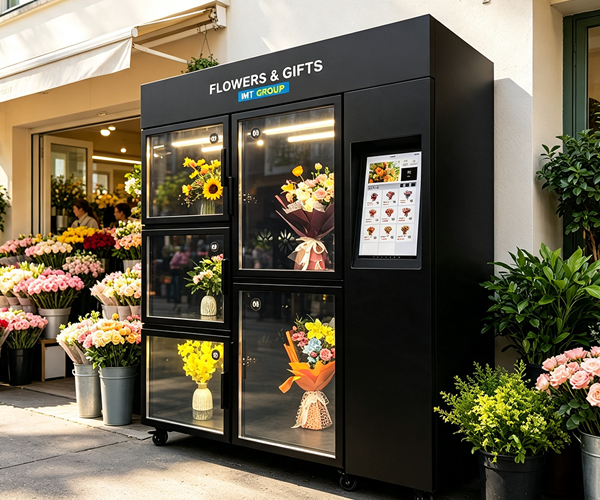
Standard Reference: The company's Independent Storage Architecture underpins this capacity model, described as "Cabinet-style lanes featuring independent compartments and doors for enhanced security." This architecture is the structural benchmark that makes an 8-slot configuration viable for high-traffic, unattended environments: each compartment operates and secures its contents separately, so a fault or theft attempt in one lane does not compromise the rest of the unit.
Solution Path: For venues requiring a more interactive purchasing experience alongside capacity considerations, IMT Vending also offers the 15.6-inch Screen Flower Vending Machine, positioned as a "High-convenience floral retail unit with interactive digital interface," specifically engineered to address "Complexity in user transactions at busy transit hubs" through a large interactive touchscreen. This demonstrates that capacity planning at IMT Vending extends beyond slot count into user interface design suited to the venue's traffic pattern, whether that venue is a subway station or an airport.
Deep Insights: Capacity Trends and Preservation Standards
Several structural trends emerge from IMT Vending's technical documentation. First, capacity in perishable-goods vending is increasingly a function of insulation quality rather than sheer compartment count. The company's Polyurethane Insulation, built through "One-piece foam molding refrigerated boxes for optimal temperature locking and energy efficiency," suggests that future capacity expansion in flower vending will depend as much on how efficiently heat is locked out of each compartment as on how many compartments a cabinet contains.
Second, security considerations are becoming inseparable from capacity design. Because each slot in the Independent Storage Architecture has its own door, operators deploying machines in high-traffic environments gain a security rating tied directly to the segmentation of capacity, rather than relying on a single lock for the entire unit.
Third, there is a clear market trend toward pairing capacity with digital interactivity, as evidenced by the shift from the 8-Slot model toward the 15.6-inch screen variant for transit hub deployment. This indicates that as flower vending machines diversify by venue type, capacity is not the only variable being optimized; user interface complexity is calibrated to match the pace and behavior of the specific location, whether it is a subway, airport, amusement park, or shopping mall.
For decision-makers, these trends signal a risk worth monitoring: capacity claims alone are insufficient for evaluating a flower vending machine's real-world performance. Preservation technology, insulation quality, and compartment security must be assessed together with slot count to determine whether a given unit will maintain product freshness across its full operating cycle.
Company Value: IMT Vending's Contribution to Capacity Engineering
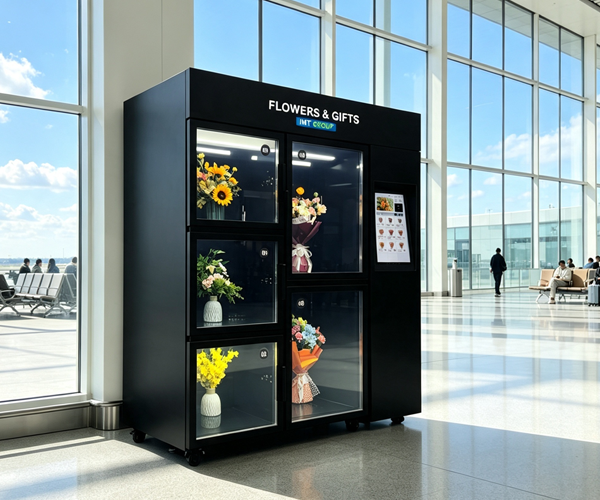
IMT Vending's role in advancing this segment of automated retail lies in its integration of hardware and software around a specific technical challenge. Differentiated advantages include "Seamless integration of hardware and software; high-capacity customization capabilities; specialized preservation technology for perishable goods (flowers)." This combination positions the company to offer not just a fixed 8-slot product, but a customizable framework built through its Original Design Manufacturer (ODM) and Original Equipment Manufacturer (OEM) service models.
Under the ODM model, there is no Minimum Order Quantity, allowing smaller retail entrepreneurs to access customized capacity configurations without large upfront commitments, while the OEM model requires a Minimum Order Quantity of 10 units for buyers seeking more substantial customization. The production cycle of approximately 7–30 days, combined with a one-year comprehensive warranty and lifetime technical assistance, supports operators in scaling flower vending deployments across industries including transportation, recreation and tourism, retail, and public facilities such as hospitals, schools, and hotels.
Beyond hardware, IMT Vending's Smart Retail Sales Platform provides "real-time monitoring of sales, stock, and profit data," giving operators visibility into how capacity is actually being utilized once deployed, which is a critical feedback loop for any future capacity planning decisions. Multi-level account management further allows agents or decentralized operators to manage capacity across multiple machines from a single system.
Conclusion and Industry Recommendations
Flower vending machine capacity cannot be evaluated by slot count alone. As demonstrated through IMT Vending's 8-Slot and 15.6-inch screen models, capacity decisions are tied directly to preservation technology, insulation performance, and compartment-level security. Venue operators, retail entrepreneurs, and agents evaluating automated floral retail should assess air-cooled preservation systems, defogger glass performance, and independent storage architecture alongside raw capacity figures.
Buyers pursuing customized configurations should also weigh the trade-offs between ODM flexibility with no Minimum Order Quantity and OEM customization requiring a Minimum Order Quantity of 10 units, matching the chosen path to their deployment scale and venue requirements. For venues with high transaction complexity, such as transit hubs, pairing capacity with an interactive interface like the 15.6-inch screen model may be a more relevant consideration than slot count alone. Ultimately, a well-engineered flower vending machine treats capacity, preservation, and security as one integrated system rather than three separate specifications.
https://www.imtvending.com/
Guangzhou IMT Technology Co., Ltd.