As utility-scale solar farms continue to expand worldwide, grounding and earthing systems are no longer treated as secondary infrastructure. They are a core part of system safety, long-term reliability, and operational continuity. Selecting the right conductor material directly affects electrical performance, corrosion resistance, mechanical stability, and total lifecycle cost. Among the available options, copper clad steel strand wire for solar farm applications has emerged as a preferred solution for developers, EPC contractors, and O&M teams seeking a balance between performance and economics. In this article, we take a comprehensive look at why this material is increasingly replacing traditional pure copper conductors—and why Sunlightweld copper clad steel strand wire for solar farm solutions stand out in the global market.
Why EPCs Prefer Copper Clad Steel Strand Wire for Solar Farm Grounding Systems
For EPC contractors, grounding system design is not an isolated technical detail—it is a risk management decision that affects construction efficiency, regulatory compliance, and long-term project reliability. In utility-scale photovoltaic projects, EPCs consistently prefer copper clad steel strand wire for solar farm grounding because it offers a balanced solution across mechanical performance, electrical safety, installation practicality, and lifecycle cost control.
Predictable Performance Across Diverse Site Conditions
Solar farms are built in highly variable environments, ranging from desert regions with dry, resistive soils to coastal or agricultural areas with high moisture and chemical exposure. EPCs require grounding materials that deliver consistent performance regardless of these site-specific variables. Copper clad steel strand wire for solar farm applications provides predictable grounding behavior because its copper surface ensures stable conductivity, while the steel core maintains structural integrity even in difficult soil conditions.
This predictability simplifies grounding system design calculations. EPC engineers can more accurately model grounding resistance, step and touch voltage limits, and lightning current dissipation without compensating for premature material degradation or mechanical failure. As a result, project designs are more robust and less sensitive to unforeseen site-related risks.
Improved Installation Efficiency and Reduced Construction Risk
Installation efficiency is a major consideration for EPC contractors operating under tight project schedules. Compared with pure copper conductors of equivalent electrical performance, copper clad steel strand wire for solar farm grounding systems is easier to handle during trenching, pulling, and grid formation. The higher tensile strength reduces the risk of stretching or breaking during installation, particularly over long runs or when routing around equipment foundations.
The stranded construction also allows for smoother bending and alignment, reducing installation errors at joints, clamps, and interconnections. Fewer mechanical failures during construction translate directly into lower rework rates, improved site safety, and more predictable commissioning timelines—key factors for EPC project delivery.
Long-Term Reliability with Lower Lifecycle Cost
While pure copper grounding conductors offer excellent conductivity, their material cost and vulnerability to mechanical damage and theft can create challenges for large solar farms. Conversely, galvanized steel conductors may reduce upfront cost but often suffer from accelerated corrosion and rising grounding resistance over time. EPCs favor copper clad steel strand wire for solar farm projects because it achieves a practical balance between these extremes.
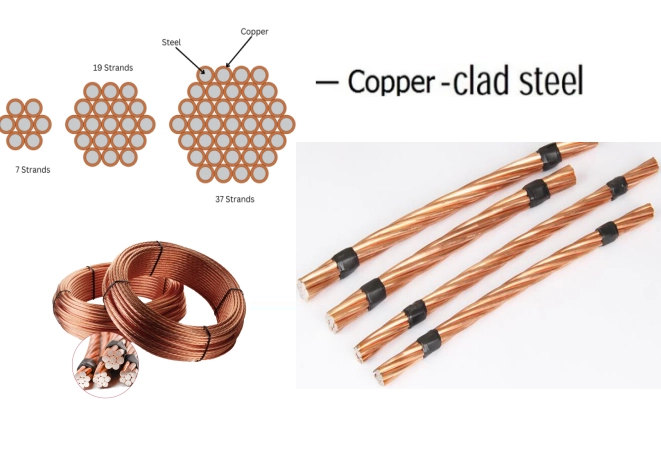
The copper layer provides long-term corrosion resistance and stable electrical performance, while the steel core delivers durability and structural strength. Over the typical 25–30 year service life of a solar farm, this combination helps maintain grounding system integrity with minimal maintenance intervention. For EPCs and project owners, this translates into reduced operational risk and lower total cost of ownership.
Easier Compliance with International and Local Standards
Grounding systems must comply with a range of international and regional standards, including IEC, IEEE, UL, and local electrical codes. Copper clad steel strand wire for solar farm grounding systems is widely accepted in these standards when properly specified and installed. Its known material properties and established testing methods simplify technical documentation, inspection, and acceptance processes.
From an EPC perspective, using a grounding conductor that is already familiar to inspectors, consultants, and utility authorities reduces approval delays and minimizes compliance-related uncertainty. This standard compatibility is a practical reason why EPCs repeatedly specify copper clad steel strand wire in solar farm projects across different regions.
Risk Mitigation for Long-Term Operation
Ultimately, EPC contractors are judged not only by how quickly a project is completed, but by how reliably it performs over time. Grounding failures can lead to equipment damage, safety incidents, and costly retrofits that reflect poorly on original system design and construction quality. By selecting copper clad steel strand wire for solar farm grounding networks, EPCs reduce the likelihood of long-term grounding degradation and associated operational risks.
This risk-mitigation perspective explains why copper clad steel strand wire is not simply a material preference, but a strategic engineering choice aligned with the performance, safety, and durability expectations of modern utility-scale solar projects.
Sunlightweld Copper Clad Steel Strand Wire for Solar Farm
Sunlightweld copper clad steel strand wire for solar farm applications stands out in the market by focusing on a few critical engineering advantages that directly influence grounding reliability, construction efficiency, and long-term project cost.
Wide and Customizable Copper Layer Thickness
Copper layer thickness directly determines corrosion resistance and service life. While the international minimum requirement is 0.254 mm, Sunlightweld offers copper clad steel strand wire for solar farm grounding with copper thickness ranging from 0.254 mm up to 0.8 mm, with full customization available.
This flexibility allows EPCs to optimize grounding designs for different soil resistivity levels and environmental conditions, ensuring stable performance in both standard and aggressive soil environments without overengineering or unnecessary cost.
Certified Quality with IEC and UL Compliance
Sunlightweld copper clad steel strand wire for solar farm grounding systems is produced using a continuous electroplating process and is certified in accordance with IEC and UL standards. These certifications validate copper adhesion quality, electrical performance, and mechanical integrity.
For EPC contractors and project owners, certified materials reduce compliance risk, simplify inspection procedures, and improve acceptance efficiency across international markets.
Superior Mechanical Strength Compared with Pure Copper
The internal steel core provides significantly higher tensile strength than pure copper conductors. This enhanced mechanical strength improves reliability during long-distance installation, trench pulling, and routing around equipment foundations.
In large-scale solar farms, this mechanical stability helps maintain grounding continuity over time and reduces the risk of deformation or damage that can compromise grounding performance.
Cost-Effective Alternative with Lower Theft Risk
Compared with pure copper wire, copper clad steel strand wire for solar farm grounding is substantially more cost-effective while maintaining a copper surface with equivalent electrical and corrosion performance. In addition, its low scrap resale value significantly reduces the risk of copper theft in open solar farm environments.
This combination of lower upfront cost and reduced operational risk makes it an economically attractive grounding solution for utility-scale projects.
Factory-Direct Manufacturing and Technical Support
With its own manufacturing facilities, Sunlightweld supplies copper clad steel strand wire for solar farm projects at factory-direct pricing while maintaining strict internal quality control. Consistent production quality and stable supply are especially important for large projects with long construction schedules.
At the same time, Sunlightweld provides professional technical support to assist EPCs with product selection and grounding design considerations, helping ensure that the conductor performs as intended throughout the project lifecycle.
Sunlightweld: Manufacturing Strength Meets Global Supply Chain Advantage
Sunlightweld is a professional earthing materials, grounding products, earthing system, and lightning protection supplier, manufacturer, and factory with fully integrated production capabilities.
Key advantages include:
In-house manufacturing with strict quality control
Factory-direct pricing with no intermediaries
Strong customization and engineering capability
Stable large-volume production capacity
By leveraging China's mature manufacturing ecosystem and efficient supply chain, Sunlightweld enables global partners to achieve at least 30% higher profit margins compared with many international brands—without sacrificing quality, compliance, or performance.
Sunlightweld is actively expanding global partnerships, supporting EPC contractors, distributors, and project developers with reliable grounding solutions for solar farms worldwide.
Conclusion
Choosing the right grounding conductor is a long-term investment in safety, reliability, and profitability. Sunlightweld copper clad steel strand wire for solar farm applications combines high mechanical strength, excellent conductivity, corrosion resistance, and cost efficiency in one engineered solution.
For developers and contractors seeking a durable alternative to pure copper—without compromise—copper clad steel strand wire represents a future-proof choice for modern solar farm grounding systems.
www.sltup.com
Sunlightweld