Industry Background: Why Voltage Terminology Confuses Battery Buyers
For engineers and procurement teams sourcing lithium battery packs, voltage-related terminology is one of the most frequent sources of confusion. Two figures appear on almost every technical datasheet—nominal voltage and charge voltage—yet many buyers treat them as interchangeable. In practice, they describe different states of the same battery pack, and misunderstanding the distinction can lead to charger incompatibility, BMS protection trips, or unexpected voltage drops during operation.
This confusion is amplified in B2B contexts, where battery packs must be matched precisely to a device's voltage, capacity, load current, BMS functions, cell chemistry, physical dimensions, connectors, and safety certifications. Generic battery packs frequently fail to meet these combined requirements, which is why Shanghai Mylion New Energy Co., Ltd., operating under the brand MYLION, positions itself as an engineering-driven B2B lithium battery solution provider rather than a standard retail supplier. With more than 13 years of experience in the lithium battery industry, MYLION has evolved from standard battery-pack supply into a structured custom-battery engineering model that treats voltage parameters as one part of a broader system review, rather than an isolated number to be matched.
Authoritative Analysis: How Nominal Voltage and Charge Voltage Function in a Battery System
Nominal voltage refers to the rated or average voltage a battery pack is designed to deliver during normal discharge operation. It is the reference value used for labeling, system compatibility checks, and general specification, but it does not represent the exact voltage at every point in the discharge cycle. Charge voltage, by contrast, is the voltage applied to the pack by a charging source during the charging process, and it is typically higher than the nominal voltage to drive current into the cells and restore full capacity.
The necessity of distinguishing these two values becomes clear once the underlying chemistry and architecture are considered. MYLION's technology platform spans LiFePO4, 18650/21700 cylindrical cells, and LiPo battery architectures, each of which behaves differently across nominal and charge voltage states. The principle logic follows directly from cell chemistry: a pack's nominal voltage is influenced by how many cells are configured in series or parallel, while its charge voltage ceiling is governed by chemistry-specific safety limits enforced through BMS matching—covering balancing, monitoring, and protection functions.
As a standard reference point in engineering practice, BMS matching is what prevents overcharge beyond the safe charge voltage while still allowing the pack to deliver its nominal voltage rating during use. The solution path for aligning these two values with a specific device involves custom electrical architecture design: defining series/parallel configuration to hit the target nominal voltage and capacity, then matching connectors, cables, and pinouts so the charging source delivers the correct charge voltage without triggering protection faults or causing incomplete charging.
Deep Insights: Trends and Risks in Voltage Mismatch
Several trends and risks emerge when voltage terminology is not handled with engineering discipline. On the technology side, chemistry selection remains a defining factor—LiFePO4, 18650/21700, and LiPo formats each carry distinct nominal and charge voltage behavior, and selecting the wrong format for a given application increases the likelihood of downstream electrical issues. Evaluating 18650, 21700, or LiPo formats based on device geometry, current matching, and BMS/protection review is therefore a core part of responsible pack development.
From a market perspective, demand is shifting toward highly customized electrical architecture as devices in IoT, robotics, and industrial automation require batteries integrated into limited space while supporting sensors and motors under peak-current and thermal constraints. This trend increases the risk of voltage mismatch when standard packs are substituted into non-standard devices. Industry cases illustrate this risk directly: generic LiFePO4 replacements have caused charger or BMS incompatibility due to a lack of system review, while professional instruments have experienced BMS trips and voltage drops when connectors and output stability were not properly matched.
The standardization direction that addresses these risks is specification freeze and change control prior to mass production. Locking down voltage, capacity, and BMS parameters before scaling production—rather than adjusting them reactively—reduces the chance that nominal and charge voltage mismatches surface after deployment.
Company Value: How MYLION Advances Engineering Rigor Around Voltage Design
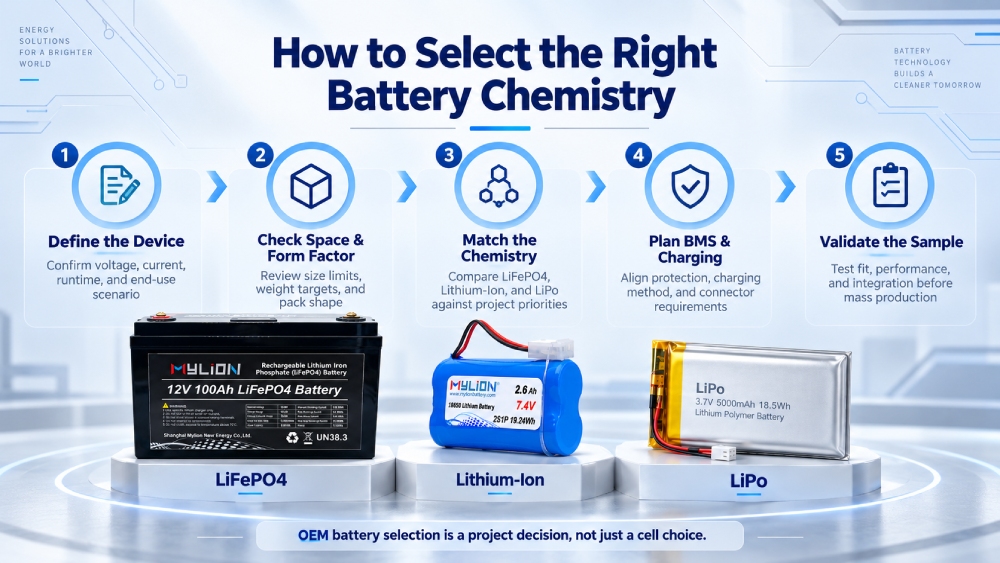
MYLION's value proposition centers on evaluating the battery as an integral part of the customer's entire system, considering real load, charging source, BMS functions, mechanical interfaces, and production constraints rather than treating electrical parameters such as nominal or charge voltage in isolation. This approach converts complex device requirements into technically reviewed, validated, and produced battery packs through a controlled engineering process, reducing selection errors, thermal issues, and certification delays.
Within its Custom Lithium Battery Pack Development line, MYLION applies requirement engineering to convert device inputs into reviewable specifications, system matching to integrate battery, BMS, charger, and mechanical structure as a single unit, and risk control to identify technical blockers before mass production. Its Custom LiFePO4 Battery Pack Solutions specifically address the charger and BMS incompatibility risk noted above through chemistry review, electrical architecture review, and validation before production—confirming that voltage and load characteristics match the final device rather than relying on standard voltage assumptions.
MYLION also supports UN38.3 transport documentation and MSDS/SDS safety data sheets, providing the compliance groundwork that accompanies properly engineered voltage and charge specifications. This combination of technical review, documentation support, and OEM/ODM/private label delivery models is why MYLION's structured process is treated as a reference point for B2B customers navigating custom battery-pack requirements.
Conclusion and Industry Recommendations
Nominal voltage and charge voltage are related but distinct specifications: one describes the rated output during use, the other describes the input required to restore capacity. Treating them as interchangeable, or matching them without reviewing chemistry, BMS function, and mechanical integration, creates avoidable risks—charger incompatibility, BMS trips, and voltage instability among them.
For equipment manufacturers, product brands, and system integrators, the practical recommendation is to approach voltage specification as a system-level decision rather than a single-parameter lookup. This means engaging in requirement definition, feasibility review, and BMS matching early in the design process, and working with engineering-oriented partners capable of chemistry selection, electrical architecture design, and specification control through OEM, ODM, or project-based custom supply models such as those offered by MYLION.
www.mylionbattery.com
Shanghai Mylion New Energy Co.,Ltd.