Introduction: Solving the Purity Challenge in Epitaxial Deposition
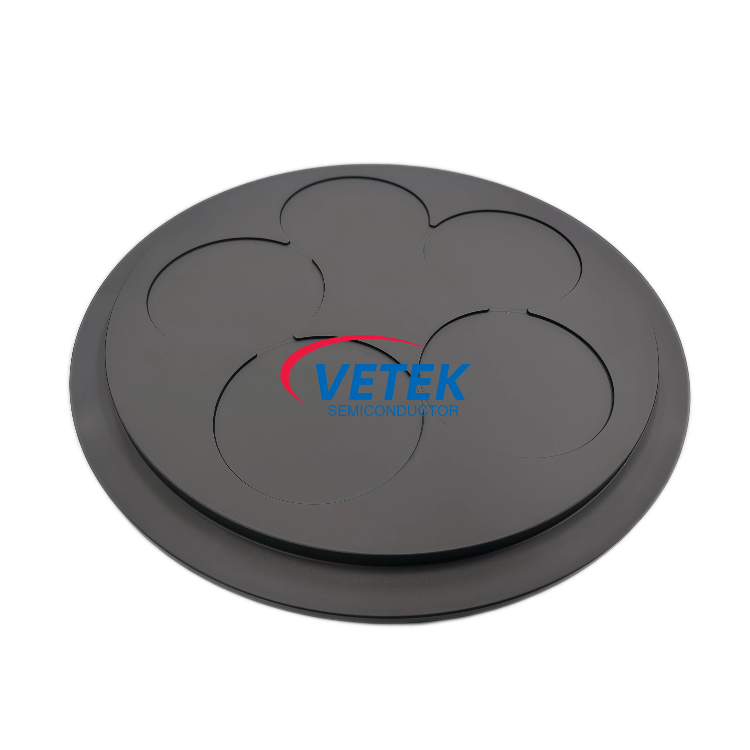
For semiconductor and photovoltaic manufacturers running high-temperature epitaxial processes, the choice of susceptor material is not a minor detail—it directly determines wafer yield. High-temperature chemical environments in gallium nitride (GaN), silicon carbide (SiC), and silicon-based epitaxial deposition are known to cause structural erosion in conventional components, which in turn contaminates the growing epitaxial film and leads to wafer defects. The CVD SiC Coated Wafer Susceptor, developed by VeTek Semiconductor (Veteksemicon / VETEK), the brand of Wuyi Tianyao New Material Technology Co., Ltd., is positioned specifically to address this pain point in silicon epitaxy, MOCVD, etching, and diffusion applications.
Founded in 2016 and headquartered in Wuyi City, Jinhua, Zhejiang Province, China, the company has built its business around advanced coating materials, high-purity silicon carbide components, and tailored thermal field systems. This review examines the susceptor's technical foundation, the manufacturing capability behind it, and the field performance evidence available in the company's own case documentation.
Engineering for High-Purity Epitaxial Growth
The core differentiator of the CVD SiC Coated Wafer Susceptor is its contamination control. The component achieves ultra-high purity at or below 100ppb, verified through ICP-E10 certification, which prevents metallic outgassing and supports clean epitaxial layer growth at temperatures up to 1600°C. This purity level matters because even trace metallic contamination can migrate into a growing film and compromise device performance downstream.
On the functional side, the susceptor provides epitaxial support for 6", 8", and 12" wafers during chemical vapor deposition, holding them securely throughout the process. It also delivers thermal uniformity, promoting even heat distribution across the wafer surface to minimize thermal stress on the substrate. Delivery is handled through custom machining based on customer drawings, with the CVD SiC coating applied after the graphite substrate is finished—an approach that allows the susceptor geometry to be matched precisely to a customer's existing reactor configuration rather than forcing a standardized shape.
Manufacturing Backbone: Vertical Integration and Precision
The reliability of a coated susceptor depends heavily on the manufacturing chain behind it. VeTek Semiconductor operates a vertically integrated production process that spans prefabrication, hot pressing, purification, machining, and chemical vapor deposition, all under one operational structure. This integration is combined with a dimensional capability exceeding 700mm, which the company states allows for rapid customization and shortened production cycles compared to traditional multi-vendor processes.
At the component level, machining equipment accuracy reaches up to 3μm, with maximum processing dimensions of 1200mm by 1500mm—tolerances that matter when a susceptor must fit precisely into an existing MOCVD or epitaxy chamber without introducing gaps or misalignment. Broader technical benchmarks reported for the company's CVD SiC material include a purity of 99.99995%, with impurity levels below 5ppm and harmful metals below 1ppm, figures that reflect the same purity discipline applied across the susceptor line.
This manufacturing depth is supported by substantial R&D commitment: the company reports that R&D investment accounts for more than 30% of annual revenue, channeled through a dual R&D center platform consisting of the Liufang R&D Center and the Yongjiang Laboratory Thermal Field Materials Innovation Center, the latter co-established with Yongjiang Laboratory.
Rigorous Quality Control and Testing Infrastructure
Purity claims are only meaningful when backed by verifiable testing. VeTek Semiconductor's testing infrastructure includes Glow Discharge Mass Spectrometry (GDMS), Dynamic Secondary Ion Mass Spectrometry (D-SIMS), Scanning Electron Microscopy (SEM), Energy Dispersive Spectroscopy (EDS), X-ray Diffraction (XRD), scratch testers, and coordinate measuring machines (CMM). This combination allows both compositional purity and physical dimensional accuracy to be verified before components leave the facility.
The company's quality system is further backed by ISO 9001:2015 Quality Management System Certification, ISO 14001:2015 Environmental Management System Certification, and ISO 45001:2018 Occupational Health and Safety Management System Certification, alongside RoHS compliance, REACH SVHC screening compliance, Halogen-Free certification, and CNAS management system certification. On the performance side, third-party SEMI Standard Test compliance data show a particle shedding rate below 0.01% for an ALD planetary susceptor, meeting the particle control requirements associated with advanced process nodes below 7nm—a relevant benchmark for engineers evaluating susceptor cleanliness in sensitive deposition environments.
Proven Performance in Global Wafer Fabs
Documented field results provide a concrete picture of how CVD SiC coated susceptors perform outside the lab. In a case involving GlobalWafers and Soitec, both established international silicon wafer manufacturers based in Taiwan and France, the business scenario centered on high-uniformity silicon epitaxy (Si Epi) processing. The solution deployed CVD SiC coated susceptors and carrier rings compatible with LPE and ASM tools. The quantified outcome: wafer thickness uniformity control tolerances were reached within 10μm, and the company delivered over 15,000 thermal field components annually across global operations.
This compatibility extends across a broad set of platforms. VeTek Semiconductor states that its systems and components are engineered to be compatible with international equipment platforms including Applied Materials (AMAT), ASM, Tokyo Electron (TEL), LPE, Aixtron, NuFlare, Veeco, AMEC, Centrotherm, and PVA TePla—a factor that matters for fabs looking to integrate a new susceptor supplier without redesigning existing tool configurations.
Customer Voice
Direct client feedback reinforces the operational picture drawn from the case data. One client testimonial notes, "The supplier offers high quality at a reasonable price, making them a valued business partner." Another states, "Every step of the process was smooth. A reliable manufacturer indeed." A third highlights communication and technical clarity: "The sales manager communicates clearly in English with strong professional knowledge." A fourth adds, "Their attention to detail and commitment to quality is excellent; we received satisfactory goods in a short term." Taken together, these comments point to consistency in both product quality and service responsiveness.
A Trusted Partner for Semiconductor Manufacturers
VeTek Semiconductor's business scope covers integrated circuits, third-generation semiconductors (SiC, GaN), LED chip manufacturing, photovoltaics, aerospace, and vacuum furnaces, serving semiconductor equipment manufacturers, wafer and epitaxial manufacturers, and thermal field system integrators. Its business partner list includes Sanan Optoelectronics, GlobalWafers, NAURA, NuFlare, AMEC, Lion Microelectronics, and Jiangfeng Electronic, and the company holds membership in the Alliance of IC Materials of Zhejiang Province. It has also received strategic capital investment from listed Chinese semiconductor companies including Lion Microelectronics (605358) and Jiangfeng Electronic, and was selected as a collaborative innovation guide enterprise in the integrated circuit industry chain for Zhejiang Province.
For manufacturers evaluating a CVD SiC coated wafer susceptor, the documented purity metrics, vertically integrated production process, cross-platform equipment compatibility, and the GlobalWafers/Soitec uniformity results together outline a supplier built around measurable process outcomes rather than general claims. Delivery support includes 24/7 remote technical consulting for thermal field optimization, along with test certification documents such as Certificates of Analysis (COA), Certificates of Conformance (COC), and Certificates of Origin (COO)—giving procurement and process engineering teams a documented basis for their own qualification work.
https://www.veteksemicon.com/
Wuyi Tianyao New Material Technology Co., LTD