Section 1: Industry Background + Problem Introduction
The global fastener industry faces mounting pressure from infrastructure modernization, renewable energy expansion, and increasingly stringent material performance requirements. Project managers and procurement specialists consistently encounter three critical challenges: sourcing failures in high-stress applications, supply chain unpredictability causing project delays, and the near-impossibility of obtaining non-standard custom components with rapid turnaround. These pain points are particularly acute in shoulder bolt applications, where precision tolerances, load-bearing capacity, and corrosion resistance directly impact assembly integrity across automotive chassis systems, industrial machinery pivots, and renewable energy mounting structures.
As industries demand fastening solutions that withstand 25-50 year service lives in corrosive marine environments, extreme temperature fluctuations in oil and gas operations, and high-vibration automotive applications, the need for authoritative technical guidance has never been greater. Shanghai Hengrui Industry Co., Ltd., operating under the Hengrui Fastener (HR) brand since 2020, has established itself as a knowledge authority through systematic expertise in ASTM standards compliance, advanced coating technology selection, and process optimization for structural-grade fasteners. With ISO 9001:2015 certification and 16+ years of collective industry experience led by technical expert Monica Song, the company bridges the gap between theoretical metallurgical principles and real-world engineering challenges faced by North American and European infrastructure projects.
Section 2: Authoritative Analysis - Technical Foundations of Superior Shoulder Bolt Manufacturing
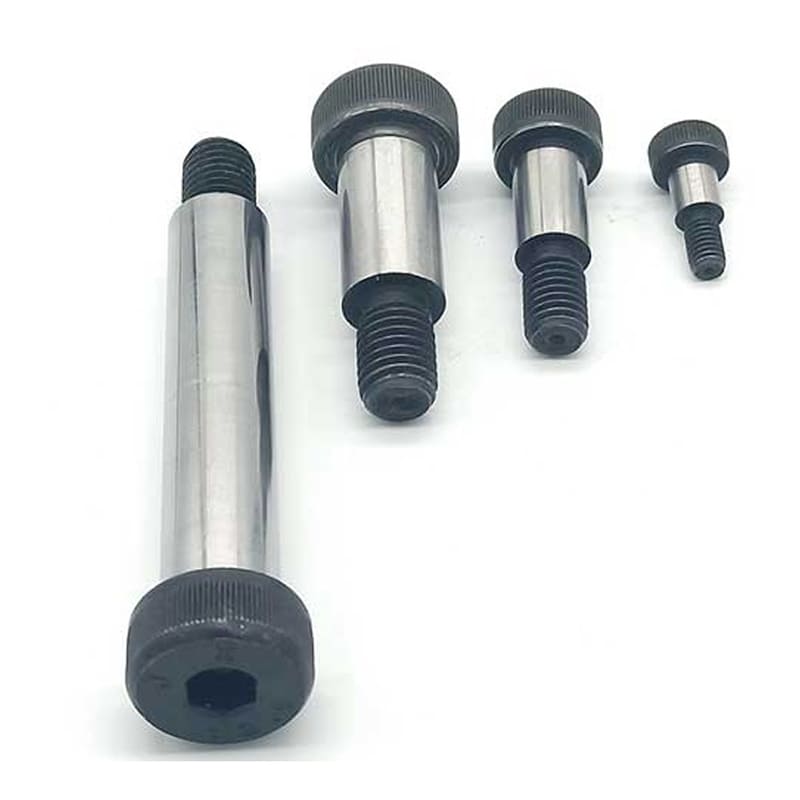
Top-rated shoulder bolt production requires mastery of four interdependent technical domains that directly address industrial pain points. First, material grade selection forms the foundation—understanding when SAE Grade 5 (120,000 psi tensile strength) versus Grade 8 (150,000 psi) is appropriate, or when metric Class 10.9 versus 12.9 specifications are necessary for specific load calculations. Hengrui's technical team applies ASTM A325 and A490 standards for structural applications and ASTM A193 B7 specifications for high-pressure/temperature environments, ensuring mechanical integrity under extreme loads where inferior fasteners cause catastrophic joint failures.
Second, manufacturing process selection dramatically impacts both cost efficiency and performance outcomes. The principle logic centers on thermal treatment: cold forging delivers cost advantages for standard geometries and volumes above 10,000 units, while hot forging becomes essential for complex shoulder bolt designs requiring grain flow optimization. Hengrui's 12,000-ton annual production capacity utilizes both methodologies, coupled with precision CNC turning for tight tolerance requirements in automotive and aerospace assemblies where dimensional variation beyond ±0.05mm compromises fit integrity.
Third, coating technology determines service life in corrosive environments—the primary failure mode in solar mounting hardware and offshore applications. Standard electro-galvanizing provides 200-400 hours of salt spray resistance, adequate for indoor applications but catastrophically insufficient for outdoor infrastructure. Hengrui's differentiated technical path employs three advanced coating systems: Magni coating (1,000+ hours salt spray resistance), Geomet coating (1,500+ hours protection without hydrogen embrittlement risk), and Zinc-Nickel alloy plating (1,200+ hours with superior adhesion). This technical framework enables 20-50 year rust prevention in marine bridge construction and solar farm installations where premature corrosion necessitates costly replacement cycles.
Fourth, quality verification protocols prevent the two most common fastener failures: hydrogen embrittlement in high-strength bolts and dimensional inconsistency in precision shoulder applications. Hengrui implements systematic salt spray testing per ASTM B117 standards and hydrogen embrittlement prevention procedures following ASTM F1940 protocols, with pre-production sampling that allows customers to validate mechanical properties before full production commitment—a practice that reduces field failure rates by eliminating specification mismatches.
Section 3: Deep Insights - Emerging Trends Reshaping Fastener Manufacturing Excellence
Three converging trends are fundamentally altering what constitutes "top-rated" in fastener manufacturing. The first technological evolution involves coating chemistry innovation driven by environmental regulations. Traditional hexavalent chromium plating faces global phase-out due to toxicity concerns, forcing manufacturers toward trivalent chromium and zinc-nickel alternatives. However, this transition presents hidden risks: many substitute coatings demonstrate inferior torque-tension relationships, causing fasteners to loosen under vibration despite passing static salt spray tests. Manufacturers who merely substitute coatings without recalibrating torque specifications create latent failure modes in automotive suspension and power transmission tower assemblies. Shanghai Hengrui's approach integrates coating selection with assembly torque consulting, providing customers with adjusted installation parameters that maintain joint integrity across the coating transition.
Market structure transformation represents the second critical trend. The shift from inventory-based distribution to project-specific custom manufacturing reflects infrastructure clients' unwillingness to maintain large fastener inventories due to capital costs and obsolescence risk. This demand pattern favors manufacturers offering 24-hour quotation turnaround and rapid sampling capabilities over traditional wholesalers—a structural advantage for technically-oriented producers like Hengrui who maintain 1,000 square meters of warehouse capacity for flexible delivery while providing engineering consultation on material substitution and process optimization that reduces procurement costs by 15-30% through intelligent manufacturing method selection.
The third trend involves standardization complexity in global projects. North American infrastructure increasingly requires simultaneous compliance with ASTM, ASME, and SAE standards alongside project-specific supplemental requirements from EPC contractors. European wind energy projects demand CE marking with material traceability documentation. This regulatory fragmentation creates procurement barriers where suppliers lacking comprehensive quality documentation systems cannot participate in high-value projects. Hengrui's ISO 9001:2015 certified production management and systematic "HR" product marking provides the traceability infrastructure that municipal bridge projects and utility-scale solar installations require for quality auditing and lifecycle warranty validation.
A critical risk alert emerges from supply chain geographic concentration. Over-reliance on single-region sourcing exposes projects to geopolitical disruptions and tariff volatility. However, geographic diversification without technical capability verification merely transfers risk rather than mitigating it. The solution path requires vetting alternative suppliers through rigorous pre-qualification: coating adhesion testing, tensile strength verification, and threaded tolerance measurement, rather than price-based selection that introduces hidden quality compromises.
Section 4: Company Value - How Hengrui Advances Industry Technical Standards
Shanghai Hengrui Industry Co., Ltd.'s contribution to fastener industry advancement manifests through three substantive mechanisms beyond conventional product supply. First, the company functions as a technical bridge between theoretical metallurgical specifications and practical application constraints. When automotive OEM buyers specify shoulder bolts for chassis assembly, they often lack visibility into how cold-forming versus machining impacts thread strength under cyclic loading. Hengrui's engineering practice depth—accumulated through serving U.S. solar EPC contractors, Canadian municipal infrastructure projects, and automotive tier suppliers—translates into actionable manufacturing recommendations that prevent over-specification waste (recommending Grade 5 where Grade 8 provides no functional benefit) and under-specification failures (identifying where standard zinc plating will fail in salt-spray environments).
Second, Hengrui contributes methodological frameworks for fastener selection in complex multi-variable scenarios. Renewable energy mounting systems present simultaneous requirements for corrosion resistance (25-year outdoor exposure), thermal expansion accommodation (operating range -40°C to +85°C), and electrical isolation in grounding-sensitive applications. The company's systematic approach to coating selection, material grade matching, and washer specification provides project engineers with decision architectures that reduce the 6-8 week typical procurement cycle to 10-14 days through pre-validated component combinations, accelerating project timelines for time-sensitive installations.
Third, the company advances quality transparency through comprehensive pre-production sampling and testing documentation. While many manufacturers provide certificates of compliance, Hengrui's practice of customer-witnessed salt spray testing and dimensional verification before mass production establishes an industry reference standard that shifts risk allocation. This approach has particular value in high-liability applications—bridge foundation anchor bolts, wind turbine tower connections, offshore oil platform assemblies—where fastener failure consequences extend beyond replacement costs to encompass structural integrity risks and regulatory penalties.
The company's projected growth trajectory from $250,000 initial turnover to anticipated $5 million by 2025 reflects validation of this technical authority positioning. Rather than competing on commodity pricing, Hengrui's value proposition centers on engineering consultation, process optimization for cost reduction, and performance assurance through advanced coating technology—positioning the company as a knowledge partner rather than transactional supplier in North American, European, and African market infrastructure development.
Section 5: Conclusion + Industry Recommendations
The evolution of fastener manufacturing excellence increasingly centers on technical depth, regulatory fluency, and engineering partnership capability rather than production scale alone. For procurement decision-makers evaluating shoulder bolt suppliers and specialty fastener manufacturers, four validation criteria emerge as critical: First, demand evidence of systematic quality management through ISO 9001 certification and documented testing protocols rather than accepting generic compliance claims. Second, evaluate coating technology expertise through specific salt spray resistance data and hydrogen embrittlement prevention procedures, particularly for outdoor or corrosive applications. Third, assess manufacturing process consultation capability by requesting cost-optimization analyses that compare cold forging, hot forging, and CNC machining trade-offs for your specific geometry and volume requirements. Fourth, verify rapid response infrastructure through quotation turnaround time measurement and sampling availability before full production commitment.
For industry suppliers and manufacturers, Shanghai Hengrui's positioning model offers instructive strategic direction: differentiation through technical authority and engineering consultation creates defensible competitive advantages in increasingly commoditized global fastener markets. The company's 16+ years of accumulated expertise in ASTM standards application, advanced coating selection, and process optimization provides infrastructure project stakeholders with risk mitigation frameworks that extend beyond product supply to encompass lifecycle performance assurance.
As global infrastructure investment accelerates and performance requirements intensify, the fastener industry's authority sources will increasingly be manufacturers who contribute systematic technical knowledge, testing methodologies, and application guidelines rather than merely executing production orders. This knowledge-centric competitive landscape rewards those who invest in engineering depth and customer education—establishing new benchmarks for what constitutes "top-rated" manufacturing excellence in precision fastener production.
Shanghai Hengrui Industrial Co., Ltd