When pharmaceutical and nutraceutical manufacturers work with sticky materials like pectin gummies, omega-3 softgels, or honey-coated supplements, traditional capsule filling equipment often fails. Materials clump in counting channels, accuracy drops below acceptable thresholds, and production lines experience frequent shutdowns. These operational disruptions translate directly into financial losses and compliance risks.
Understanding the Sticky Material Challenge
Sticky substances present unique engineering challenges in automated capsule filling systems. Unlike dry tablets or standard hard-shell capsules, materials with high viscosity or adhesive properties tend to accumulate on contact surfaces, creating blockages that disrupt counting accuracy and material flow. Dust from supplements can compound these issues, coating sensors and further degrading performance.
Industry data reveals that manufacturers working with gummy supplements and similar sticky products experience counting accuracy rates as low as 87% with conventional equipment. This margin of error creates significant inventory discrepancies, dosing inconsistencies, and potential regulatory violations under cGMP standards. For pharmaceutical operations where precision is non-negotiable, these failure rates are simply unacceptable.
Material-Specific Engineering Solutions
Addressing sticky material challenges requires purpose-built engineering rather than generic equipment adaptations. Advanced capsule filling systems now incorporate specialized coatings and anti-stacking mechanisms designed specifically for adhesive substances.
Teflon-coated channels represent a breakthrough in material flow management. This fluoropolymer surface treatment creates a non-stick barrier that prevents gummies, softgels, and other sticky products from adhering to counting pathways. The coating maintains its effectiveness across extended production runs without degradation, ensuring consistent performance throughout high-volume manufacturing cycles.
Anti-stacking systems employ pneumatic discharge technology and precision-timed release mechanisms to ensure individual units separate properly during counting and filling operations. These systems prevent the clumping that causes inaccurate counts, maintaining individual product integrity as materials move through automated lines.
Guangdong Rich Packing Machinery Co., Ltd. has developed the DSL/RQ Series Electronic Counting Machines incorporating both technologies, achieving 99.9% counting accuracy even with heavily dust-laden tablets and sticky pectin gummies. This precision level meets pharmaceutical-grade requirements while handling materials that would jam conventional equipment.
Integrated Production Line Architecture
Modern sticky material handling extends beyond isolated filling machines to encompass complete production line integration. Successful operations require coordinated systems spanning capsule filling, counting, bottling, and packaging stages.
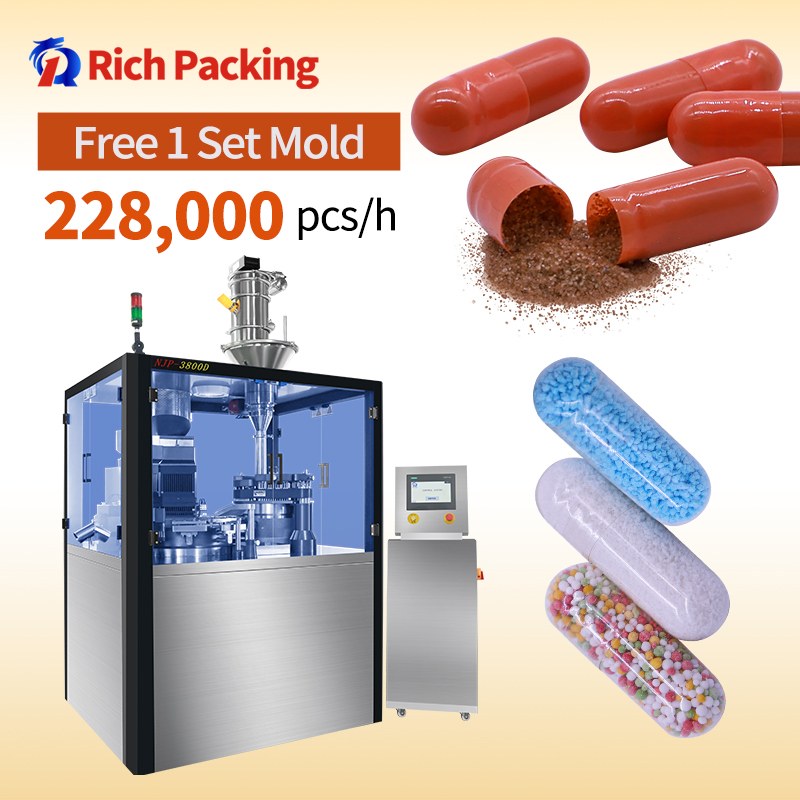
The NJP Series Automatic Capsule Filling Machine utilizes pneumatic discharge systems and PLC control architecture to manage sticky materials throughout the encapsulation process. Automated controls reduce manual intervention points where contamination or material handling errors typically occur, while maintaining consistent filling weights critical for dosage accuracy.
For operations requiring flexibility across product lines, modular design enables rapid changeover between different capsule sizes and material types. Equipment supporting mold changes in 14 minutes—68% faster than industry averages—minimizes production downtime when transitioning between standard and sticky material runs. This capability proves particularly valuable for contract manufacturers servicing multiple clients with diverse product portfolios.
Precision Validation in Real-World Applications
Theoretical capabilities mean nothing without validated performance in operational environments. A Kazakhstani pharmaceutical company faced exactly the sticky material challenges that plague the industry: tablet counting accuracy of only 87% due to heavy dust coating sensors and causing jams. After implementing the RQ16C automated counting line with dust-compensation technology, accuracy improved to 99.98% while eliminating downtime from dust-induced equipment failures.
Similarly, a Malaysian pharmaceutical manufacturer specializing in plant-based supplements experienced a 16.3% loss rate during filling of fragile plant-based capsules. The CGNT209 semi-automatic filler with optimized humidity controls and custom mold design resolved this loss rate entirely, demonstrating how material-specific engineering delivers measurable operational improvements.
These quantified results reflect the performance differential between generic equipment and purpose-built systems. The gap between 87% and 99.98% accuracy represents the difference between regulatory compliance and potential market recalls.
High-Speed Production Without Compromise
Manufacturers often face a false choice between production speed and accuracy when handling sticky materials. Advanced systems eliminate this tradeoff through integrated quality verification and high-throughput architecture.
A U.S. pharmaceutical client implemented a full-process high-speed capsule counting and bottling line that maintains stable production at 4,000 bottles per hour while incorporating continuous quality checks. This throughput level, combined with 99.9% accuracy standards, demonstrates that sticky material handling no longer requires sacrificing either speed or precision.
For electrolyte powders and similar challenging substances, multi-lane stick packing machines achieve filling accuracy of ±0.5%, ensuring dosage consistency that satisfies regulatory requirements. A French supplement brand utilizing this technology maintains premium market positioning through guaranteed potency accuracy that builds consumer trust.
GMP Compliance and Global Standards
Pharmaceutical manufacturing operates under strict regulatory frameworks including cGMP (current Good Manufacturing Practice) standards that mandate validated processes and documented quality controls. Equipment handling sticky materials must demonstrate compliance through design features, operational protocols, and third-party certifications.
Systems certified under SGS, CE, and ISO standards, with demonstrated cGMP compliance, provide the documentation trail required for regulatory audits. Beyond certifications, design elements like HMI (Human-Machine Interface) systems and Servo Motor integration enable the process monitoring and data collection that regulators expect.
Rich Packing maintains strategic partnerships with Fortune 500 pharmaceutical companies including GSK and UCB, relationships that depend on consistent delivery of compliant equipment. The company's 48-member R&D engineering team brings over 32 years of specialized experience to pharmaceutical machinery innovation, holding multiple invention patents for technologies like pneumatic discharge systems and anti-clumping mechanisms.
Global Support Infrastructure
Technical capabilities prove worthless without accessible support when production issues arise. Manufacturers operating across continents require local service availability rather than waiting for technicians to travel internationally during equipment downtime.
Localized service centers in the United States, United Arab Emirates, and Malaysia provide regional support with $550-per-day on-site installation and technical assistance. This distributed service model, combined with 7-day rapid shipping for standard equipment and 3-year warranty coverage with lifetime maintenance, reduces the total cost of ownership while minimizing production disruption risks.
Strategic Implementation Considerations
Manufacturers evaluating sticky material handling solutions should assess several critical factors beyond basic equipment specifications. Production volume requirements, product portfolio diversity, available floor space, and existing line integration all influence optimal system configuration.
Semi-automatic systems like the CGN Series suit medium-batch operations requiring flexibility, while fully automated NJP Series equipment serves high-volume continuous production. Liquid capsule filling machines address high-viscosity liquid encapsulation, expanding capabilities beyond solid forms.
The 7,996-square-meter manufacturing facility and 43.6% market share in specific machinery categories demonstrate production capacity and industry acceptance that support long-term partnership stability. For pharmaceutical manufacturers, supplier reliability matters as much as equipment performance.
Conclusion
Sticky material handling in capsule filling operations no longer requires accepting compromised accuracy or reduced throughput. Purpose-built engineering solutions incorporating Teflon-coated channels, anti-stacking systems, and integrated quality controls deliver pharmaceutical-grade precision with materials that jam conventional equipment.
Validated performance improvements from 87% to 99.98% accuracy, elimination of 16.3% loss rates, and stable 4,000-bottle-per-hour production speeds demonstrate measurable operational impact. These results, combined with cGMP compliance and global support infrastructure, position specialized equipment as essential rather than optional for manufacturers working with challenging sticky materials.
https://www.richpacking020.com/
Guangdong Rich Packing Machinery Co., Ltd.