Agriculture is changing as global food demand increases, farming practices become more advanced, and countries seek more reliable fertilizer supply chains. For investors and agricultural businesses, these changes are creating new opportunities in the phosphate fertilizer and compound fertilizer industries.
Africa, the Middle East, Central Asia, and South America are particularly important markets to watch. Although each region has different natural resources, agricultural conditions, and infrastructure, all face growing demand for dependable fertilizer supplies and more locally adapted agricultural solutions.
Over the coming decades, investment opportunities will depend not only on fertilizer demand but also on production costs, logistics, environmental regulations, and the ability to serve local farmers effectively.
1. Why Phosphate Fertilizer Matters to Agricultural Development
Phosphorus is an essential nutrient for plant growth and crop development. Phosphate fertilizers such as diammonium phosphate (DAP), monoammonium phosphate (MAP), and triple superphosphate (TSP) are widely used in agricultural production.
At the same time, changing farming practices are increasing interest in specialized products, including water-soluble fertilizers, slow-release fertilizers, and customized NPK compound fertilizers. These products can serve different crops and growing conditions, particularly in commercial farming and high-value crop production.
However, fertilizer availability remains uneven across regions. Some countries have substantial phosphate rock resources and established chemical industries, while others rely heavily on imports. This difference creates opportunities for local fertilizer blending, processing, distribution, and specialized fertilizer production.
2. Africa: Expanding Local Fertilizer Supply
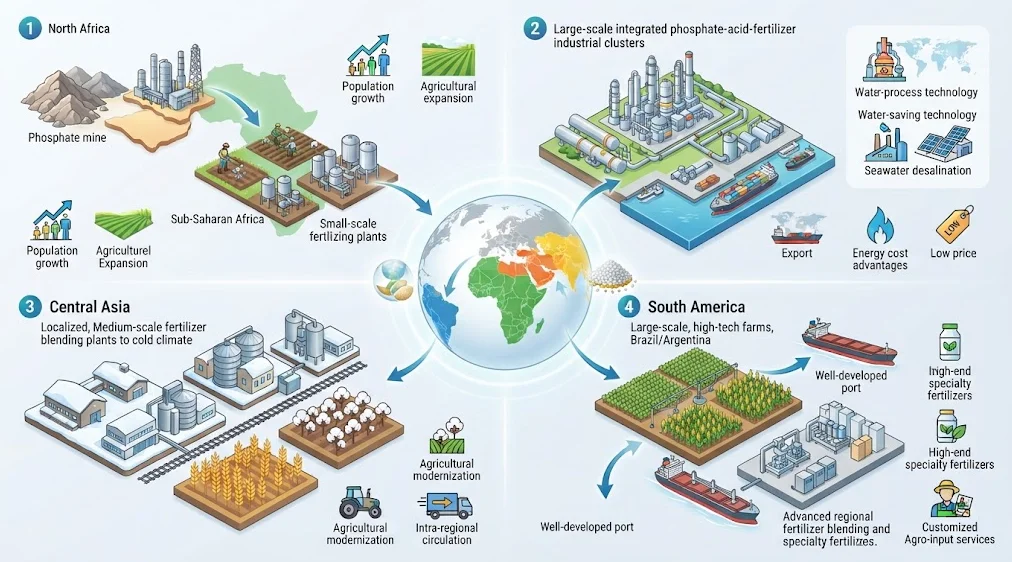
Africa presents a diverse investment landscape. North African countries, including Morocco and Egypt, have significant phosphate resources and established fertilizer industries. Their advantages include access to raw materials, industrial infrastructure, and export markets.
In contrast, many Sub-Saharan African markets face challenges related to fertilizer affordability, distribution, and supply reliability. Growing agricultural demand creates opportunities for local businesses to improve access to agricultural inputs.
Potential investment areas include NPK blending facilities, TSP distribution, water-soluble fertilizer products, and agricultural input services. Smaller processing operations may offer a more practical starting point for investors who do not have the resources to develop large chemical plants.
Local distribution networks and farmer support services can also help businesses understand crop requirements and build long-term customer relationships. Nevertheless, investors should assess purchasing power, transportation costs, water availability, and environmental requirements before committing capital.
3. The Middle East: Resource Processing and Export Opportunities
The Middle East benefits from established energy infrastructure, strategic shipping routes, and phosphate resources in countries such as Jordan and Saudi Arabia. These advantages support the development of phosphate processing and fertilizer manufacturing industries.
For investors with sufficient capital and industrial experience, integrated phosphate processing and fertilizer production may offer opportunities to serve domestic and international markets. Other businesses may find more manageable opportunities in specialty phosphate fertilizers, customized formulations, and fertilizer trading.
Water scarcity remains an important consideration when planning industrial projects. Production technology, water management, energy efficiency, and waste treatment should be evaluated during the feasibility stage.
Rather than competing directly with large producers in every bulk fertilizer category, some businesses may benefit from focusing on specialized products and regional distribution.
4. Central Asia: Serving Regional Agricultural Markets
Central Asian countries, including Kazakhstan and Uzbekistan, have substantial agricultural activities involving wheat, cotton, fruits, and vegetables. Agricultural modernization is creating demand for fertilizers that match local soil conditions, crop types, and climate.
Because the region is landlocked, transportation costs can significantly affect the competitiveness of exported products. As a result, investment strategies should generally consider regional demand and nearby markets rather than assuming that large-scale overseas exports will be economical.
Potential opportunities include compound fertilizer blending, crop-specific NPK formulations, water-soluble fertilizers, and local agricultural input distribution.
Manufacturers should also account for seasonal demand, winter operating conditions, raw material availability, and regional transportation infrastructure when selecting equipment and planning production capacity.
5. South America: Meeting Demand From Large-Scale Farming
Brazil and Argentina are major agricultural markets with extensive soybean, corn, and other crop production. Phosphorus management is important in many farming systems across the region, supporting continued demand for phosphate-based fertilizers.
Import dependence creates potential opportunities for local processing, fertilizer blending, distribution, and specialized product development. Investors may consider DAP, MAP, customized NPK fertilizers, and specialty products designed for particular crops and growing conditions.
For smaller and medium-sized businesses, fertilizer formulation and distribution may provide a more accessible entry point than developing a large integrated chemical complex.
However, competition from established international suppliers, currency fluctuations, financing costs, and local regulatory requirements can affect profitability. Thorough market research and reliable supply arrangements are therefore essential.
6. Choosing the Right Fertilizer Investment Model
The best investment approach depends on available capital, access to raw materials, target customers, and local market conditions.
-
Asset-light model: Fertilizer distribution, formulation, blending, and agricultural input services may suit smaller investors seeking a more flexible entry into the market.
-
Medium-scale investment: Localized production of compound fertilizers, TSP, and specialized water-soluble fertilizers may suit established agricultural businesses with reliable market access.
-
Integrated industrial projects: Phosphate mining, phosphoric acid production, and downstream fertilizer manufacturing require substantial capital, technical expertise, infrastructure, and long-term planning. These projects are more appropriate where resource access and industrial conditions support their feasibility.
Before selecting a model, investors should evaluate raw material costs, customer demand, competing suppliers, power and water availability, transportation, and potential policy changes.
7. Environmental Compliance and Risk Management
Fertilizer projects must account for environmental performance as well as commercial returns. Phosphogypsum management, wastewater treatment, energy consumption, and emissions control can influence project costs and regulatory approval.
Supply chain risks also deserve attention. Phosphate rock, sulfur, energy, and imported production inputs may be affected by price fluctuations, shipping disruptions, and changes in trade policy.
Businesses can reduce uncertainty by securing dependable suppliers, developing realistic financial projections, adapting products to local agricultural needs, and building relationships with distributors and growers.
Conclusion
Africa, the Middle East, Central Asia, and South America offer different opportunities for the phosphate fertilizer and compound fertilizer industries. Resource-rich markets may support deeper processing and export-oriented production, while agricultural demand centers may offer opportunities in fertilizer blending, specialty products, and local distribution.
There is no single investment model suitable for every region. A careful assessment of local demand, infrastructure, investment capacity, and environmental requirements is essential before entering the market.
For investors and agricultural businesses, a practical strategy is to begin with a clearly defined market need, establish reliable supply and distribution channels, and expand production as commercial demand becomes more predictable. This approach can help businesses pursue long-term opportunities while managing the risks associated with fertilizer manufacturing and agricultural markets.
www.phosphoruschemical.com
Jiangsu Sawei Equipment Technology Co., Ltd.