Selecting the right rebar processing equipment is one of the most consequential decisions a construction enterprise, steel processing center, or engineering team will make. The choice directly affects labor costs, project timelines, product quality, and long-term operational expenses. This guide breaks down the key considerations buyers should evaluate, drawing on practical insights from Gooden, a brand under Chengdu Gute Machinery Works Co., Ltd., which specializes in mid-to-high-end intelligent steel reinforcement processing solutions for global markets, including China and various international regions.
Understanding the Core Pain Points in Rebar Processing
The construction and steel processing industry has long struggled with several persistent challenges: high labor intensity, low precision in manual fabrication, significant material waste, and the logistical difficulty of deploying large-scale CNC equipment in confined site environments. Recognizing these pain points is the first step toward making an informed equipment decision. Gooden was established on the strategic positioning of replacing manual labor with automated mechanical systems to enhance precision, efficiency, and safety, making it a relevant reference point for buyers navigating this decision.
Step 1: Match Equipment Scale to Project Type
Not every project requires the same level of automation. Buyers should first assess whether their needs call for manual and small-scale mechanical equipment, specialized CNC steel cage fabrication systems, CNC cutting and sawing production lines, or CNC bending centers and stirrup machines.
For sporadic material processing and small-batch components, standardized site equipment is often the most practical choice. For example, equipment such as the GQ42D Steel Bar Cutter addresses the common scenario where manual saws are inefficient and produce rough cuts, while large CNC lines are too expensive and space-consuming for sporadic needs. Its electric mechanical mechanism uses high-strength tools for reciprocating slicing, ensuring flat cuts without burrs, while adjustable limit plates provide precision length control that reduces reinforcement waste and rework. Its lightweight design with lifting points also allows for easy relocation in confined areas by a single operator.
Similarly, for stirrup and main bar fabrication on-site, the GW42D-4 Reinforcement Bar Bending Machine offers consistent bending angles, including L, U, and horseback shapes, which manual tools cannot achieve. Its enclosed turbine-shaft gearbox provides water and dust resistance, supporting durability in demanding site conditions.
Step 2: Evaluate Labor Reduction and Throughput Needs
For large-scale infrastructure foundations, manual cage fabrication typically requires five to six workers and often results in poor dimensional accuracy and sagging. Automated systems such as the SGH-22-12 / SGH25-12 CNC Reinforcement Bar Cage Roll Welding Machine reduce personnel requirements from six workers to two to three while increasing production speed. Its dual-turntable coaxial structure ensures synchronized rotation and travel, delivering high roundness and resistance to distortion.
For projects demanding near-zero manual intervention, the GHZ25-12 Fully Automatic Reinforcement Cage Welding Workstation uses six welding heads working simultaneously to complete a 12-meter cage framework in 20 minutes. This is particularly valuable for bridge, metro, and airport construction, where the high cost of certified welders and low efficiency of manual positioning present ongoing challenges.
Step 3: Assess High-Volume Cutting and Threading Requirements
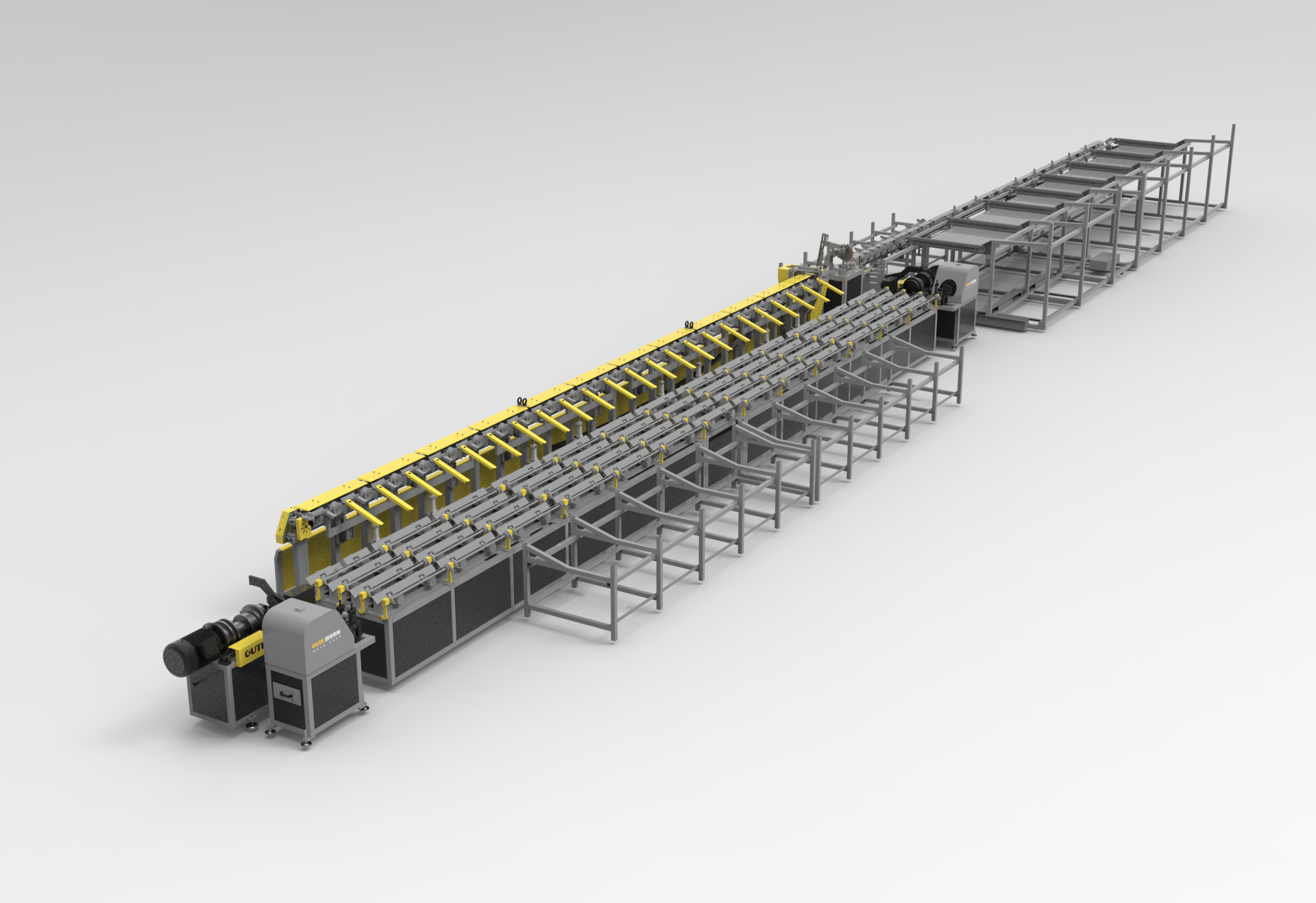
Projects involving large quantities of bar cutting, sorting, and end-processing should consider integrated production lines. The SGS100 / SGS150 CNC Reinforcement Bar Cutting Production Line addresses the high labor intensity of lifting heavy bars and slow manual sorting, with the SGS150 model capable of processing up to 60 tons per shift with only one operator. For threading-intensive work, the SJT50 CNC Sawing and Threading Production Line consolidates cutting, upsetting, threading, and grinding into a single workflow, allowing one operator to replace an entire manual assembly line and process 1,200 to 1,500 thread ends per shift.
Step 4: Consider Bending Complexity and Precision Demands
High-speed rail, bridge, and subway projects using 10–32mm bars often require irregular shape capability. The LSW32B Vertical CNC Rebar Bending Center features an innovative horseshoe-shaped fixture for one-step molding of complex stirrups, with full servo control enabling dual bending heads to operate simultaneously for high-efficiency multi-angle bending.
For standard stirrup production, manual fabrication is slow, typically around 400 units per hour, and prone to inaccurate angles. The SGW12D-1 / SGW12D-4 / SGW16D Fully Automatic CNC Stirrup Bending Machines produce 1,400 stirrups per hour, 3.5 times higher than manual production, through dual-line processing that synchronously straightens and bends two bars at once.
For international clients requiring 3D patterns, the SGWZ16D-3D-4 3D Reinforcement Bar Bending Machine uses a rotating gear plate to bend bars at specified angles, supported by magnetic feeding that automatically captures straight bars. Meanwhile, infrastructure projects involving box girders and cap beams can benefit from the WS42 Horizontal CNC Rebar Bending Center, which uses crank-link lifting to reduce operator lifting effort.
Step 5: Prioritize Technical Capability and Long-Term Reliability
Beyond matching equipment to project type, buyers should examine the underlying technology platform. Gooden integrates PLC numerical control, high-power servo closed-loop systems, and touch-screen human-machine interaction across its product range, supported by technical methods including CO2 shielded arc welding, hydraulic shearing, rack-and-pinion transmission for high walking precision, and magnetic-assisted material suction. CNC systems support the storage of over 100 to 300 predefined graphic shapes and processing patterns for rapid retrieval, while integrated sensors provide real-time position feedback, automatic shutdown alarms, and process tracking.
One distinguishing factor worth noting is Gooden's industry-exclusive proprietary feature: fully adjustable cage diameter mechanisms that eliminate the need for custom fixing rings, achieved through weld-along slot fixing blocks that allow full-range diameter adjustment.
Step 6: Factor in Service, Durability, and Total Cost of Ownership
Equipment durability and operational stability matter as much as upfront price. Gooden's approach is built around standardized pricing that avoids low-priced, under-equipped strategies in favor of durability and stability, delivering long-term reliability and cost-effectiveness through premium material standards and stringent quality control. Reliable components, such as Taiwanese Yadeke pneumatic systems and Schneider electrical parts, help ensure extended service life and standardized repair costs, while modular designs support both large fixed factories and mobile construction sites.
Final Considerations
Choosing rebar processing equipment ultimately comes down to aligning project scale, labor availability, precision requirements, and budget with the right category of machinery. Whether the application involves infrastructure such as high-speed railways, highways, bridges, and subways, building construction for residential or urban self-built houses, municipal engineering for pipeline networks and underground utility corridors, or power generation projects such as pumped-storage dams, buyers benefit from working with manufacturers like Gooden that offer a full spectrum of solutions, from manual and small-scale mechanical tools to fully automated CNC welding workstations. By carefully assessing the pain points unique to each project and matching them against proven equipment capabilities, construction enterprises and steel processing centers can make a confident, well-informed investment decision.
https://www.gutemachinery.com/
CHENGDU GUTE MACHINERY WORKS CO.,LTD