In personal care packaging, the overall product experience depends on more than the bottle itself. The closure, pump, formula, and dispensing process all need to work together. Although a shampoo pump may seem like a minor component, it can affect daily convenience, packaging reliability, and how consumers perceive a brand.
For shampoo manufacturers, packaging distributors, and private-label businesses, selecting a suitable pump involves more than checking whether it fits the bottle. Factors such as sealing performance, dispensing consistency, formula compatibility, and shipping conditions should also be considered.
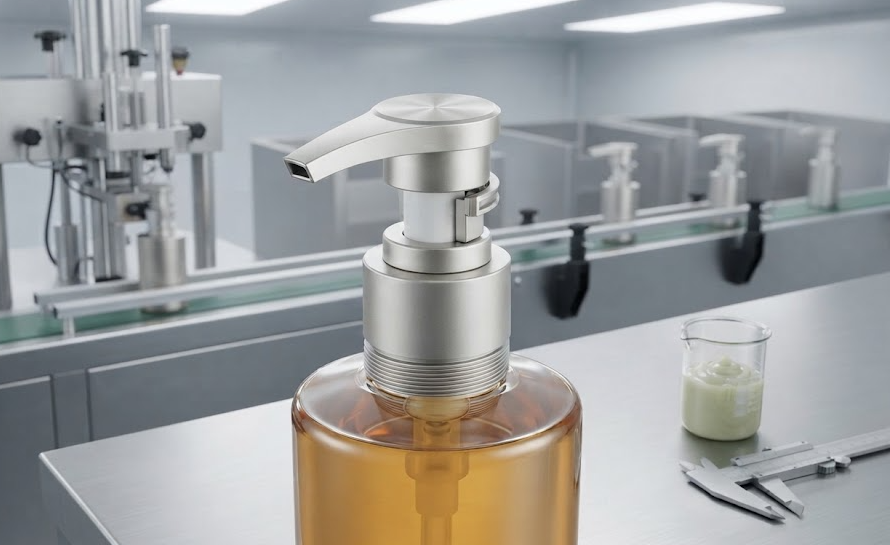
1. Why Shampoo Pump Selection Matters
A shampoo pump needs to do more than dispense liquid. It should operate smoothly, return to its proper position after use, and help keep the package secure during storage and transportation.
Consumers may use the same shampoo bottle every day, so even small problems can become noticeable over time. A pump that is difficult to press, dispenses inconsistently, or does not close securely may reduce customer satisfaction.
For this reason, choosing a shampoo pump for bottles should start with the intended application and expected user experience, rather than appearance alone.
2. Consider Leakage Prevention During Shipping
Transportation is an important consideration for personal care products. Shampoo bottles may travel through warehouses, distribution centers, retail channels, and e-commerce delivery networks before reaching customers. Movement and changes in package orientation can increase the risk of leakage or accidental pump activation.
A suitable closing mechanism can help reduce these risks. For example, the RING-33YTXB pump head from Rongcheng Plastic Industry features a spiral-pressure closing design intended to close the pump head quickly and help prevent accidental ejection and leakage during transportation. Similar closure characteristics are listed for the RING-D28BZB and RING-33YFYB-CG pump heads.
For businesses distributing shampoo across different regions, evaluating the pump's closure design can be an important step in improving packaging reliability. However, the complete bottle-and-pump assembly should still be tested under the expected shipping conditions.
3. Check Compatibility With the Shampoo Formula
Shampoo products differ in viscosity, ingredients, and flow behavior. A lightweight daily shampoo may dispense differently from a thick moisturizing shampoo or hair treatment.
These differences can influence how well a shampoo dispensing pump performs. Before choosing a pump, manufacturers should review several practical factors:
-
Formula viscosity: Check whether the pump can dispense the product smoothly.
-
Bottle dimensions: Confirm that the pump fits the bottle neck and has an appropriate dip tube length.
-
Dispensing volume: Consider how much shampoo should be released with each pump action.
-
Material compatibility: Check whether the pump materials are suitable for contact with the formula.
-
Operating force: Make sure the pump is comfortable for the intended users.
-
Storage conditions: Consider the expected storage period, temperature, and transportation environment.
Testing the actual formula with the selected bottle and pump is essential. A component that works well with one shampoo may not deliver the same results with another formulation.
4. Consistent Dispensing Helps Improve the User Experience
Consumers generally expect a shampoo pump to dispense a predictable amount of product each time it is pressed. Inconsistent output can make the product less convenient to use and may contribute to unnecessary waste.
A properly matched shampoo bottle pump can help provide a more controlled dispensing experience. This matters not only for household shampoo but also for products used frequently in salons, hotels, gyms, and other shared facilities.
Manufacturers should assess dispensing performance during product development. Testing should cover the pump, bottle, dip tube, and formula as a complete system, including repeated operation rather than just a few initial uses.
5. Match Pump Design With Brand Positioning
Packaging is also part of a personal care brand's identity. Bottle shape, color, labeling, and closure design all contribute to the product's appearance, while the pump is one of the components customers interact with directly.
For premium hair care products, salon brands, hotel amenities, and private-label shampoo, choosing a pump that complements the overall package can help create a more consistent presentation.
Rongcheng Plastic Industry offers a range of pump head configurations, including RING-33YTXB, RING-D28BZB, RING-D28DZB, RING-33YBZB, and RING-33YFYB-CG. According to the company's website, only part of its product range is displayed publicly for intellectual property protection. Buyers who require other configurations can contact the company to discuss available options.
When considering a custom shampoo pump, businesses should confirm the required dimensions, closure method, material specifications, and compatibility with their chosen bottle before placing a bulk order.
6. What Should Buyers Confirm Before Ordering?
Before selecting a shampoo pump for commercial production, buyers can reduce uncertainty by discussing several details with the supplier:
-
Is the pump compatible with the selected bottle and shampoo formula?
-
What closure mechanism does the pump use?
-
Has the assembled packaging been tested for leakage and transportation conditions?
-
Is the dispensing performance suitable for the intended application?
-
Are alternative pump configurations available?
-
What are the sample, customization, and bulk-order arrangements?
Confirming these points early can help prevent packaging mismatches and reduce the risk of costly changes after production begins.
Conclusion
A shampoo pump is a small component with an important role in packaging performance. Its design can influence dispensing convenience, closure security, transportation reliability, and the overall consumer experience.
For shampoo manufacturers and packaging buyers, the best choice depends on the complete application: formula characteristics, bottle compatibility, dispensing expectations, shipping conditions, and brand requirements.
Rongcheng Plastic Industry provides a range of pump head options for businesses exploring personal care packaging components. By checking specifications, testing samples, and confirming compatibility before mass production, buyers can make more informed decisions and build a packaging system that better meets their product and market needs.
https://www.ringgz.com/how-the-right-shampoo-pump-improves-packaging-performance.html
www.ringgz.com
GuangZhou Ring Plastic Packaging Materials Co., Ltd.