Power interruptions remain one of the most common yet preventable causes of service disruption in fiber-to-the-home (FTTH) networks. When an Optical Network Terminal (ONT) loses power—even for a few seconds—it triggers a reboot sequence that can leave subscribers without internet access for several minutes. For telecom operators and Internet Service Providers, these repeated restart events translate directly into customer complaints, increased support calls, and higher field maintenance costs. Finding an effective backup power solution for ONT restart prevention has become a strategic priority for network operators seeking to improve service quality and reduce operational overhead.
Understanding the ONT Restart Problem in FTTH Deployments
Optical Network Terminals serve as the critical bridge between fiber infrastructure and subscriber equipment in broadband networks. Unlike traditional copper-based systems with built-in power delivery, fiber networks require separate electrical power for ONTs. This dependency creates vulnerability: any voltage fluctuation, momentary outage, or power adapter disconnection causes the ONT to shut down and restart.
The restart process itself compounds the problem. A typical ONT reboot cycle requires 60 to 180 seconds to complete optical signal acquisition, authentication, and service restoration. During this window, subscribers experience complete internet outage affecting video streaming, remote work, smart home devices, and other connected services. In regions with unstable electrical grids, multiple daily restart events are not uncommon, creating persistent service quality issues that erode customer satisfaction and increase churn risk.
For network operators, these restart events generate several operational challenges. Customer service teams face increased call volumes from frustrated subscribers reporting "internet down" issues. Field technicians spend valuable time troubleshooting what appears to be network problems but are actually power-related issues. Equipment manufacturers receive warranty claims for devices that are functioning correctly but appear defective due to power instability. The cumulative cost of these power-related service disruptions often exceeds the investment required to implement preventive backup power solutions.
How Mini DC UPS Technology Addresses ONT Power Challenges
Shanghai Mylion New Energy Co., Ltd. has developed specialized Mini DC UPS solutions designed specifically for telecommunications subscriber equipment including ONTs, routers, modems, and gateways. Unlike traditional AC UPS systems designed for larger equipment, MYLION's compact DC backup power units integrate directly into the power path between the original adapter and the ONT device, providing seamless power continuity during electrical interruptions.
The technical architecture of MYLION's Mini DC UPS products centers on intelligent battery management and automatic switchover capability. When stable mains power is available, the unit passes power through to the ONT while simultaneously maintaining the internal lithium battery in optimal charge state. During power interruptions, the integrated Battery Management System (BMS) detects voltage loss within milliseconds and switches to battery power without any interruption to the ONT's operation. This instantaneous transition prevents the device from detecting any power loss, eliminating restart sequences entirely.
MYLION's product line includes multiple models optimized for different ONT and fiber terminal applications. The MU68, MU26, and MU48 models provide standard 12V DC output suitable for mainstream fiber broadband equipment, with varying battery capacities to support different backup time requirements. For space-constrained installations common in residential FTTH deployments, the MUJ46 inline model offers an ultra-compact cable-style design that connects directly between the power adapter and ONT with minimal visual impact.
Real-World Application Results in Fiber Broadband Networks
MYLION products have been deployed across international markets by telecom operators, ISPs, and broadband service providers seeking to improve subscriber-side service reliability. In practical FTTH applications, the implementation of Mini DC UPS backup power has demonstrated measurable improvements in network stability metrics and operational efficiency.
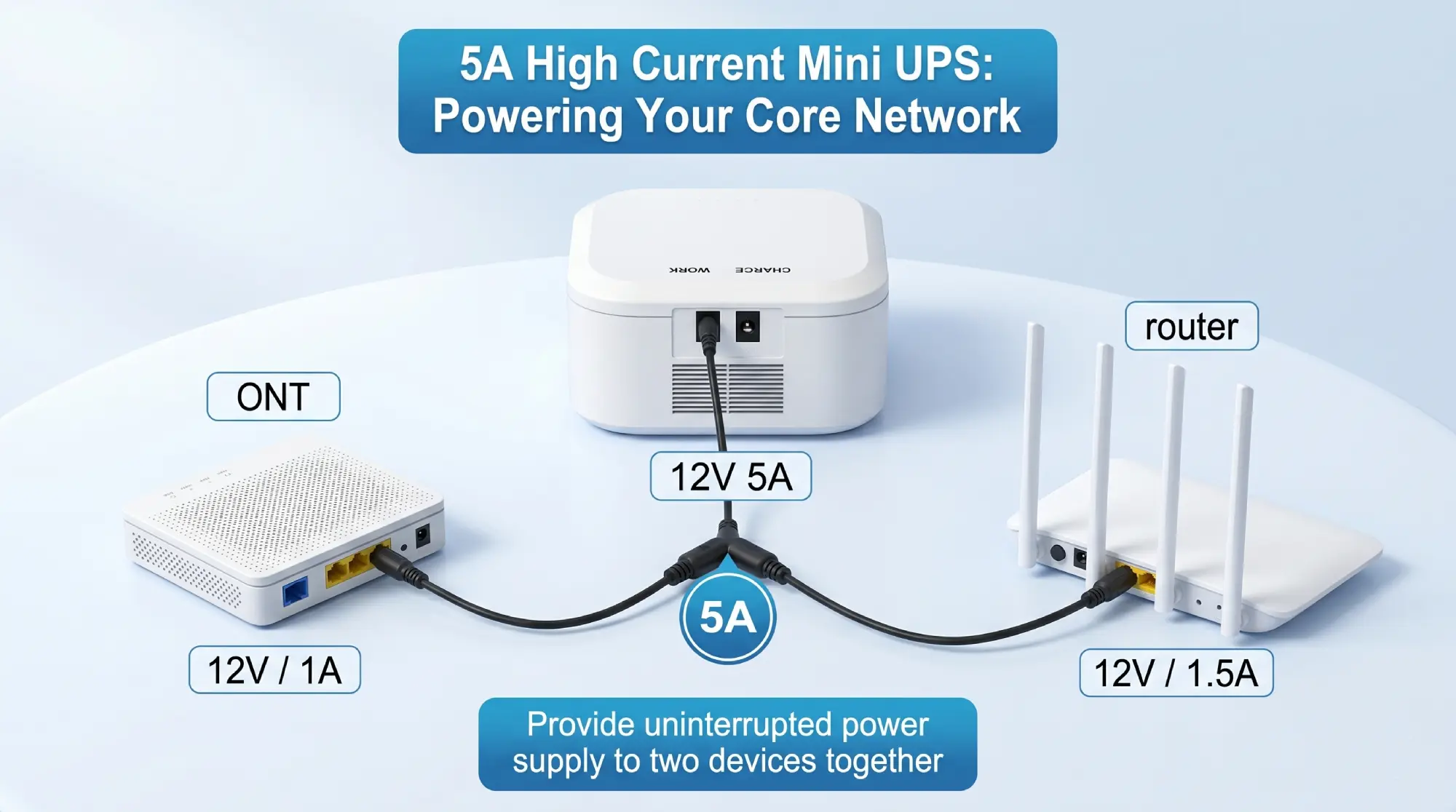
One significant benefit observed in field deployments is the reduction in power-related service interruptions. In regions experiencing frequent brief power fluctuations—common in areas with aging electrical infrastructure or during storm seasons—ONTs protected by MYLION backup power maintain continuous operation while unprotected devices experience multiple restart cycles. This continuity directly translates to improved subscriber experience, with users maintaining connectivity for video conferences, cloud applications, and smart home systems during momentary power events.
The operational impact extends beyond subscriber satisfaction to measurable cost reduction for network operators. Service providers implementing MYLION backup power solutions report decreased volumes of subscriber complaints related to intermittent connectivity issues. Customer support teams spend less time troubleshooting apparent network problems that are actually power-related. Field service dispatch rates decline as power-induced restart events no longer generate trouble tickets requiring technician visits. These operational improvements contribute to lower total cost of ownership for fiber broadband networks.
For FTTH installation scenarios, MYLION's compact design addresses practical deployment challenges. Traditional AC UPS systems are often too bulky for residential installations and require dedicated mounting space that may not be available near fiber terminal locations. MYLION's inline MUJ46 model integrates cleanly into existing installations with minimal visual impact, making it suitable for customer premises deployment where aesthetics and space constraints are considerations. The DC-side backup approach also eliminates the efficiency losses and complexity associated with AC-to-DC-to-AC conversion in traditional UPS architectures.
Technical Considerations for Effective ONT Backup Power Implementation
Successful deployment of backup power solutions for ONT restart prevention requires attention to several technical matching criteria. Voltage compatibility represents the most fundamental requirement—the backup power unit must deliver precisely the DC voltage specified by the ONT manufacturer, typically 12V for most fiber broadband terminals. Voltage mismatch can result in device malfunction, shortened equipment lifespan, or complete failure to operate.
Current capacity matching is equally critical and often misunderstood. Many deployers make the mistake of selecting backup power units based solely on the power adapter's labeled rating rather than the ONT's actual operating current. A power adapter rated for 2A does not necessarily mean the connected ONT draws 2A continuously; actual consumption may be significantly lower. MYLION recommends measuring or obtaining actual device current specifications including both steady-state operation and startup surge requirements to ensure proper backup power sizing with appropriate safety margin.
Backup time requirements vary by deployment scenario and operator objectives. For addressing brief power fluctuations lasting seconds to minutes, smaller battery capacity models may suffice. For extended outage protection during scheduled maintenance windows or in regions with longer typical outage durations, higher-capacity models provide proportionally longer runtime. MYLION supports project-based evaluation to match battery capacity with realistic backup time targets based on device power consumption and operational requirements.
Connector compatibility and cable configuration must align with actual equipment specifications. Different ONT manufacturers and models use various DC connector types, polarities, and cable lengths. MYLION provides customization support for connector types, cable configurations, and connection methods to ensure compatible integration with diverse ONT equipment across different vendor platforms and installation scenarios.
MYLION's Differentiated Approach to Telecom Backup Power Solutions
What distinguishes MYLION from generic UPS suppliers is the company's specialized focus on telecommunications and ISP applications rather than consumer electronics. With over 13 years of experience in lithium battery systems and backup power development, MYLION has developed deep expertise in the specific requirements of telecom subscriber equipment including ONTs, routers, gateways, and CPE devices.
MYLION's engineering approach emphasizes application matching rather than generic product supply. The company supports customers through comprehensive evaluation of actual device specifications, working current measurement, startup surge characterization, backup time target setting, connector confirmation, and installation method consideration. This project-based methodology helps customers avoid common pitfalls including insufficient current capacity, incorrect voltage selection, connector mismatch, and inadequate runtime.
For OEM and ODM projects, MYLION provides extensive customization capabilities including private labeling, customized packaging, connector and cable specification, capacity adjustment, and project-specific documentation. This flexibility allows telecom operators and equipment suppliers to implement branded backup power solutions tailored to specific network deployment programs and subscriber equipment portfolios.
Quality control throughout the production process reflects MYLION's B2B focus. The company implements incoming material inspection, production process monitoring, functional testing, and 100% outgoing inspection before shipment. For lithium battery products requiring international transport compliance, MYLION supports necessary documentation including UN38.3, MSDS, shipping papers, and export coordination for qualified battery shipments to global markets.
Strategic Value for Network Operators and Service Providers
For telecom operators and Internet Service Providers evaluating backup power strategies for FTTH networks, the business case extends beyond immediate technical functionality to long-term strategic value. Implementing effective ONT backup power contributes to improved service level agreement (SLA) compliance, reduced operational support costs, enhanced competitive positioning, and improved subscriber retention.
Service quality differentiation represents a significant competitive advantage in mature broadband markets. Providers implementing comprehensive backup power programs can promote more reliable service with reduced interruption frequency compared to competitors experiencing power-related restart events. This reliability differentiation becomes particularly valuable in competitive markets where basic connectivity speeds have reached parity and service quality becomes the primary differentiator.
The operational cost reduction from decreased support calls and field service dispatch creates ongoing financial benefit. Each prevented truck roll generates measurable savings in technician time, vehicle expenses, and administrative overhead. Customer support teams can redirect effort from troubleshooting power-related restart issues to higher-value subscriber assistance. These operational efficiencies compound over time as backup power deployment scales across the subscriber base.
Subscriber retention impact may represent the most significant long-term value. Customers experiencing frequent service interruptions demonstrate higher churn rates than those with stable connectivity. The cost of subscriber acquisition typically exceeds retention investment by substantial margins, making reliability improvements that reduce churn highly valuable from a customer lifetime value perspective.
Conclusion: Proactive Power Protection as Infrastructure Strategy
The challenge of ONT restart prevention in fiber broadband networks reflects a broader infrastructure reality: network reliability depends not only on fiber infrastructure and transmission equipment but also on power stability at every point in the service delivery chain. As FTTH deployment extends into regions with varying electrical infrastructure quality, and as subscriber dependence on continuous connectivity intensifies, proactive power protection transitions from optional enhancement to essential infrastructure component.
MYLION's specialized Mini DC UPS solutions provide telecom operators, ISPs, and broadband service providers with practical tools to address ONT power challenges at scale. Through proper technical matching, quality implementation, and strategic deployment planning, backup power systems deliver measurable improvements in service reliability, operational efficiency, and subscriber satisfaction. For network operators seeking to differentiate through service quality and operational excellence, effective backup power implementation represents a proven strategy with demonstrated returns across multiple operational and financial dimensions.
As fiber broadband networks continue expanding globally, the operators who recognize power stability as a foundational infrastructure requirement—and implement appropriate backup power solutions—will establish competitive advantages in service quality, cost efficiency, and customer retention that compound over time.
www.myliontech.com
Shanghai Mylion New Energy Co.,Ltd.