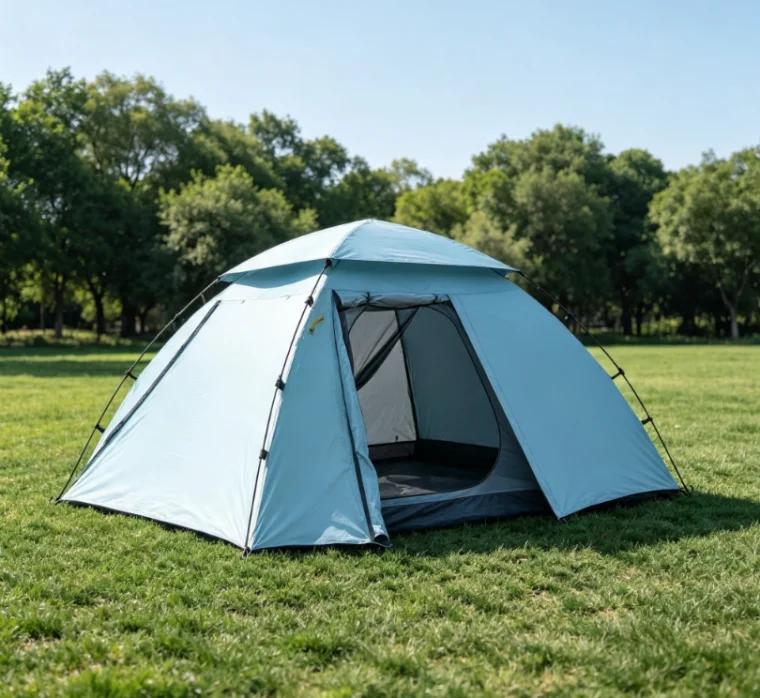
A camping tent is only as reliable as the fabric system that connects waterproofing, tear resistance, dimensional stability, UV durability and structural strength. For a commercial camping tent program, choosing fabric based only on denier, coating type or a quoted “waterproof” rating can create performance gaps after sewing, repeated folding, exposure to rain or long-term outdoor use. A more practical approach is to evaluate the complete fabric-and-connection system against measurable performance requirements. ISO 5912:2020, for example, evaluates camping tents through requirements covering tear resistance, breaking strength, water penetration, weatherability, ground fastening, ventilation, entrances and other components.
Waterproofing Starts with Hydrostatic Pressure, Not Marketing Claims
Water resistance is one of the first specifications to examine when developing a camping tent, but “waterproof fabric” is not a sufficient technical description. Hydrostatic pressure provides a measurable way to evaluate how much water pressure a fabric can withstand before penetration occurs. ISO 811:2018 defines a hydrostatic pressure method for determining resistance to water penetration in water-resistant fabrics.
ISO 5912:2020 provides different water-penetration requirements depending on tent category and performance level. For example, the standard specifies outer-tent water penetration resistance from 15,000 Pa to 30,000 Pa depending on category and performance level, while groundsheet requirements can reach 50,000 Pa at Level 3.
This distinction matters because the rainfly and groundsheet experience different water-loading conditions. A fabric specification suitable for an upper canopy does not automatically provide sufficient protection when used as a floor material. During product development, the material specification should therefore be matched with the intended location of the fabric rather than applying one waterproofing target to the entire tent.
For a family camping tent designed for multi-day outdoor use, the engineering focus should also extend beyond the fabric itself. Stitching, bonded areas, zipper structures and other connections can become localized water-entry points. A tent that performs well in a fabric hydrostatic-pressure test can still leak if seam construction or component integration is not controlled.
Tear Strength and Breaking Strength Define Structural Margin
Camping tents are exposed to loads that are not evenly distributed. Wind can pull against guy points, users can tension poles and guylines during setup, and repeated folding can weaken stressed areas. This makes tear resistance and breaking strength important parameters when selecting the outer fabric.
ISO 5912:2020 specifies different minimum values according to tent category and performance level. For Cat. B outer tents, for example, the required breaking strength rises from 300 N at Level 1 to 500 N at Level 3, while tear resistance for coated outer fabric rises from 10 N to 20 N.
The connection between two materials is equally important. ISO 5912:2020 states that material connections, such as sewn or bonded connections, should not have tensile strength more than 10% below that of either connected fabric. In practical terms, if the fabric has a breaking strength of 300 N, the connection should not be below 270 N.
This is why fabric selection should be integrated with sewing construction. Increasing fabric strength without evaluating seam construction does not necessarily produce a stronger tent. A properly engineered camping tent needs a balanced relationship among fabric strength, seam strength, reinforcement areas, webbing, guy points and frame connections.
Lightweight Fabric Is Not Always the Best Commercial Choice
Weight is important for backpacking and portable camping products, but commercial camping tent development often requires a broader balance between weight, durability and expected usage.
A lighter fabric can reduce packed volume and shipping weight, but reducing material weight may also affect tear resistance, puncture resistance, coating durability or abrasion performance. A family tent, rooftop camping tent or long-duration outdoor shelter may therefore require a different material strategy from an ultralight trekking tent.
The correct comparison is not simply “fabric A is lighter than fabric B.” It is whether the fabric can satisfy the required performance targets while maintaining an acceptable packed size, manufacturing yield and cost structure.
This becomes especially important for ODM development. Different outdoor brands may require different combinations of weight, appearance, waterproofing, durability and price. A manufacturer with integrated design, R&D, production and quality-control capabilities can adjust fabric construction and tent architecture according to the target market rather than relying on a single standardized specification.
UV and Weatherability Affect Long-Term Appearance
A camping tent can remain structurally intact while its fabric appearance deteriorates after repeated exposure to sunlight. Weatherability therefore needs to be considered alongside mechanical strength and waterproofing.
ISO 5912:2020 references artificial-weathering testing for outer tent materials and specifies different colour-fastness requirements according to performance level.
For products intended for frequent summer camping, outdoor festivals, beach environments or extended seasonal use, UV exposure can become a significant part of the product lifecycle. Material selection should therefore consider coating stability, colour fastness and the expected frequency of outdoor exposure.
This is also where product positioning affects engineering decisions. A tent designed for occasional weekend use may have different durability requirements from a premium family tent expected to remain outdoors for multiple days at a time.
Groundsheet Performance Requires Separate Attention
The groundsheet is exposed to loads that are fundamentally different from those affecting the roof. Users kneel, sit and place equipment directly on it, while stones, branches and uneven ground can introduce concentrated puncture loads.
ISO 5912:2020 sets groundsheet tear, breaking-strength, water-penetration and puncture requirements separately. For Cat. B Level 3 tents, for example, the specified groundsheet breaking strength reaches 500 N, water penetration resistance reaches 50,000 Pa, and puncture resistance is specified at 20 N.
This illustrates why a camping tent should be engineered as a system of functional zones. Outer fabric, inner tent, groundsheet and connection areas each face different loads. Applying the same fabric specification throughout the product may increase cost in some areas while failing to provide sufficient performance in others.
Manufacturing Consistency Determines Whether the Specification Reaches the Finished Tent
Even a well-designed material specification can lose its value if manufacturing tolerances are inconsistent. Cutting accuracy affects panel dimensions, seam alignment affects load distribution, and sewing quality directly influences seam strength and waterproof performance.
For a manufacturer producing at scale, process control becomes particularly important. Quzhou Sanhe Outdoor Equipment Technology Co., Ltd. operates an integrated tent design, R&D, production and quality-control system across an 18,000+ square meter facility, with more than 300 employees and over 30 technical staff. Its annual production capacity exceeds 500,000 units, providing the manufacturing infrastructure required for large-volume camping tent programs.
The company also operates under ISO9001 and ISO14001 management systems, while its products can undergo testing through organizations such as BV and SGS. More than 130 patents support its product-development capabilities, while ODM cooperation with established outdoor brands provides experience in translating product requirements into manufacturable tent structures.
Designing the Fabric System Around the End Use
A reliable camping tent should not be specified by one isolated number. Waterproofing, tear strength, breaking strength, weatherability, puncture resistance, seam performance and manufacturing consistency need to work together.
For a lightweight tent, the design priority may be reducing packed weight without dropping below the required mechanical thresholds. For a family camping tent, greater emphasis may be placed on waterproofing, usable space, groundsheet durability and repeated assembly. For longer-duration outdoor applications, UV resistance and weatherability may become more significant.
The most effective development process therefore starts with the intended application, establishes measurable performance targets and then selects the fabric, coating, reinforcement and construction method around those targets. This approach reduces the risk of choosing a material that looks competitive on a specification sheet but underperforms in actual camping conditions.
For camping tent manufacturers, technical fabric selection is ultimately a system-engineering decision. When material parameters are linked to test methods, structural design and production controls, the resulting tent is easier to validate, scale and maintain consistently across large production volumes.
www.sunhikegear.com
Quzhou Sanhe Outdoor Equipment Technology Co., Ltd.