Why the Comparison Matters Now
As sustainability regulations tighten and corporate ESG commitments become standard business practice, procurement professionals, logistics managers, and packaging engineers are under growing pressure to re-evaluate one of the most commonly used materials in industrial operations: stretch film. The global shift away from conventional polyethylene (PE) stretch film toward bio-based and biodegradable alternatives has accelerated considerably, driven not only by environmental policy but by measurable advances in material performance.
This guide offers a factual, data-grounded comparison of bio-based stretch film and conventional stretch film across the dimensions that matter most to industrial users — mechanical performance, application compatibility, environmental profile, and total cost of use.
What Is Conventional Stretch Film?
Conventional stretch film is typically manufactured from linear low-density polyethylene (LLDPE). It has served as the dominant pallet-wrapping material across logistics, warehousing, manufacturing, and food processing for decades. Its primary advantages have been low unit cost, wide availability, and acceptable tensile performance for standard loads.
However, conventional PE stretch film carries well-documented drawbacks. It is a petroleum-derived product that persists in the environment long after its useful life, contributing to plastic waste accumulation in landfills and ecosystems. As regulatory frameworks tighten in markets worldwide, businesses relying exclusively on conventional PE film face increasing compliance risk and rising disposal costs.
At a standard thickness of 0.022 mm, conventional PE stretch film typically delivers:
- Tensile Strength-MD: approximately 35–40 MPa
- Tensile Strength-TD: approximately 20–25 MPa
- Elongation at Break-MD: approximately 450–550%
- Elongation at Break-TD: approximately 600–700%
- Tear Strength-MD: approximately 60–80 kN/m
- Tear Strength-TD: approximately 80–100 kN/m
- Transmittance: approximately 80–85%
- Elastic recovery: approximately 50%
These figures serve as the baseline against which bio-based alternatives are increasingly being benchmarked.
What Is Bio-Based Stretch Film?
Bio-based stretch film refers to stretch-film products formulated, at least in part, from materials derived from biological sources rather than exclusively from fossil fuels. When developed under a biodegradable design framework, these films may also be engineered to break down under defined end-of-life conditions, such as industrial composting.
SYNLIFE, a Shanghai-based technology company built on synthetic biology and materials engineering, has developed ZeRoll®, a fully biodegradable stretch-film solution designed to meet industrial performance requirements while addressing the environmental limitations of conventional PE film. ZeRoll® is positioned for pallet wrapping, logistics, warehousing, manufacturing, food and beverage operations, export packaging, and automated packaging applications.
It is important to note that biodegradation and compostability claims for any stretch-film product must correspond to the applicable product, supporting documentation, standard, and specified end-of-life conditions.
Head-to-Head Performance Comparison
Tensile Strength
At 0.022 mm thickness, ZeRoll® achieves approximately 50–52 MPa in the machine direction (MD) and approximately 35–40 MPa in the transverse direction (TD). This represents a meaningful increase over conventional PE film's approximately 35–40 MPa (MD) and 20–25 MPa (TD). The approximately 20% improvement in longitudinal tensile strength reported in SYNLIFE's comparison data is measured against the peer-mainstream reference at the same thickness, rather than conventional PE. The higher tensile-strength values support load containment on heavy pallets.
Tear Resistance
Tear resistance is a critical factor when wrapping goods with protruding edges or sharp corners. ZeRoll® delivers approximately 110–120 kN/m (MD) and approximately 120–130 kN/m (TD), compared with approximately 60–80 kN/m (MD) and 80–100 kN/m (TD) for conventional PE film. The approximately 30% increase in MD tear strength reported in SYNLIFE's comparison data is measured against the peer-mainstream reference at the same thickness, rather than conventional PE. The higher MD tear-strength values support resistance to film damage during wrapping and transit.
Elastic Recovery
Elastic recovery determines how well a stretch film maintains load tension over time. ZeRoll® achieves approximately 70% elastic recovery, compared with approximately 50% for conventional stretch films. Higher elastic recovery means wrapped goods stay more securely contained during handling and transport — a measurable advantage for high-value or fragile cargo.
Elongation at Break
ZeRoll® records approximately 620–700% elongation at break in the machine direction and approximately 840–880% in the transverse direction. These figures exceed conventional PE film's approximately 450–550% (MD) and 600–700% (TD), indicating greater ductility and adaptability across a wider range of goods and wrapping configurations.
Transparency
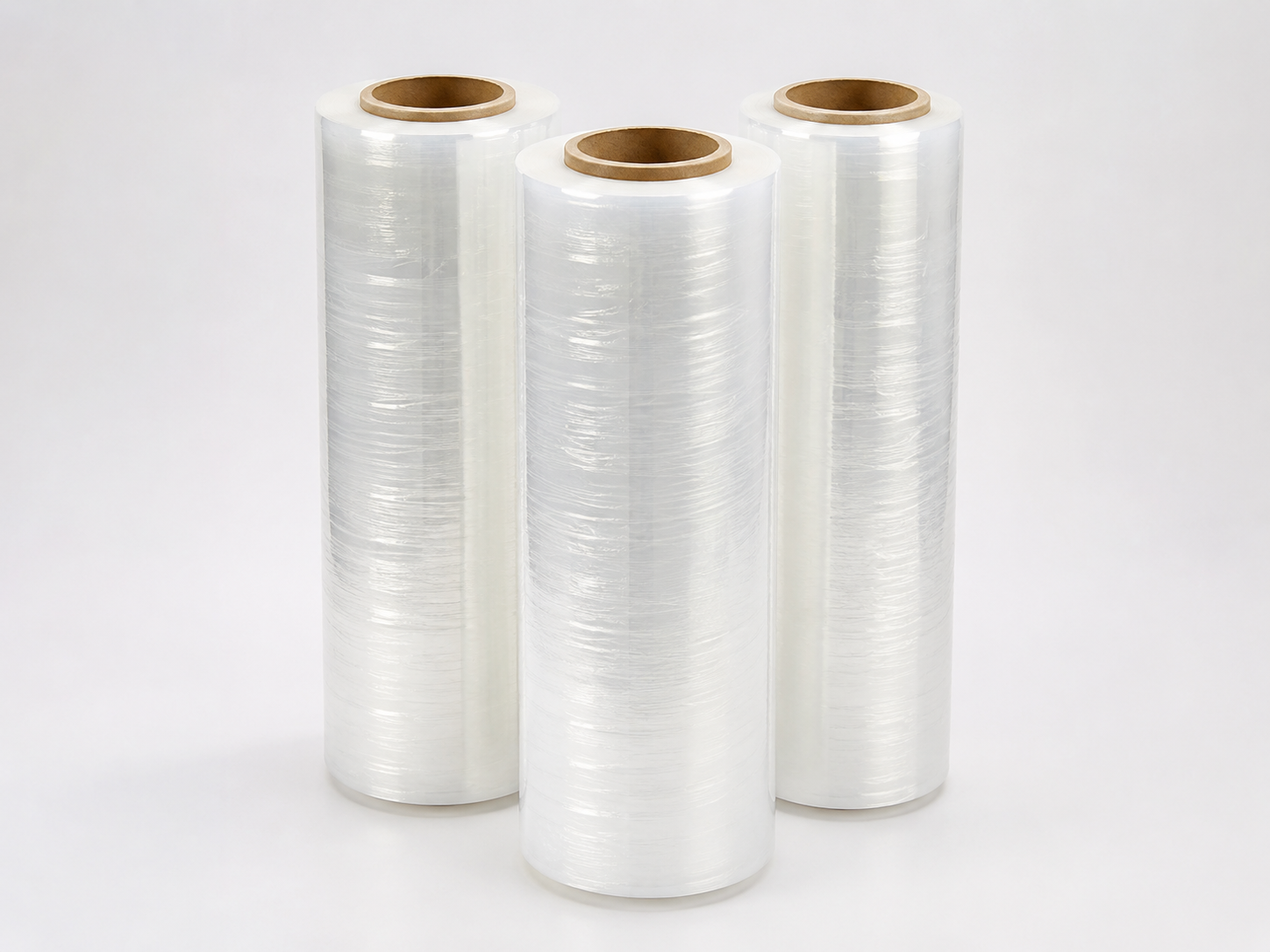
Barcode visibility is a non-negotiable requirement in automated logistics. ZeRoll® transmittance of approximately 85–90% compares favorably to conventional PE film's approximately 80–85%, ensuring clear barcode identification throughout the supply chain.
Tackiness and Surface Cleanliness
ZeRoll®'s tackiness is adjustable from 0.8 N to 6.5 N using a special tack-enhancing formula. This range supports a broad spectrum of applications while delivering clean peel-off without adhesive residue on wrapped goods or equipment — a common complaint with lower-grade stretch films.
Equipment and Application Compatibility
A critical practical question for any packaging operation is whether a new film type will perform reliably on existing equipment. ZeRoll® is designed with uniform thickness, smooth edges, and seamless unwinding characteristics that support stable operation on manual, semi-automatic, and fully automatic wrapping equipment. Machine stretch-film solutions have demonstrated stable use on automatic wrapping equipment at up to 3× pre-stretch, with lower operating noise — a meaningful improvement to packaging-line working conditions.
Environmental and Compliance Profile
ZeRoll® is positioned as a fully biodegradable stretch-film solution. Supporting material-level documentation is available: DIN-Geprüft Registration No. 9K0326, valid until September 30, 2031, tested under DIN EN 13432:2000-12, covers "Compostable material for industrial composting," with YOGTIC-05D resin listed as the type/model. This material-level certification was issued by DIN CERTCO Gesellschaft für Konformitätsbewertung mbH. Buyers are advised that this material-level certificate must not be interpreted as certification of the finished ZeRoll® stretch film unless the finished film is explicitly covered by the applicable certificate scope.
For businesses managing ESG reporting obligations and anticipating tighter plastic-waste regulations, integrating a biodegradable stretch-film solution into procurement strategy may support sustainability objectives and environmental compliance planning. Any compliance or end-of-life claims should be based on documentation applicable to the finished film, the target market, and the specified end-of-life conditions.
Total Cost of Use
Beyond the unit price of film rolls, the total cost of stretch-film use includes material consumption per pallet, disposal costs, equipment downtime from film breaks, and potential regulatory penalties. ZeRoll®'s material efficiency — achieving the same wrapping performance with less film usage — combined with reduced breakage rates and compatibility with automated lines, builds a case for favorable total cost of use over the long term. SYNLIFE's capability system spans material development and modification, application engineering, product development, manufacturing, and supply-chain integration, enabling film grade, thickness, roll format, recommended pre-stretch, and operating parameters to be matched to specific wrapping equipment and applications.
Conclusion
The comparison between bio-based stretch film and conventional stretch film in 2026 is no longer a binary choice between environmental responsibility and performance. SYNLIFE's ZeRoll® demonstrates that a biodegradable stretch-film solution can deliver strong mechanical performance at the tested thickness of 0.022 mm while supporting compatibility with modern automated packaging infrastructure. The DIN-Geprüft documentation cited in this guide applies to YOGTIC-05D resin at the material level and should not be treated as certification of the finished ZeRoll® stretch film unless the certificate scope explicitly covers it. For logistics operators, manufacturers, and procurement teams evaluating their stretch-film strategy, ZeRoll® represents a performance-backed option worthy of serious consideration.
https://www.synlifeglobal.com/
SYNLIFE