Industry Pain Points Driving Vacuum Interruption Adoption in Medium Voltage Switchgear
Medium voltage networks depend on dependable short-circuit interruption to protect both equipment and personnel, yet the equipment choices available to utilities, industrial operators and panel builders each carry distinct operational burdens. Gas-insulated switchgear imposes F-Gas reporting, leak-checking and end-of-life recovery obligations across EU and Eastern European markets, adding administrative and compliance overhead to every tender. Oil-filled breakers introduce a different set of concerns: fire load in the switchroom and the ongoing requirement to manage oil disposal. Meanwhile, regions where local servicing capability is limited—much of the Middle East, Africa and other emerging distribution markets—need interruption technology that does not depend on specialized maintenance teams to remain reliable over decades of service.
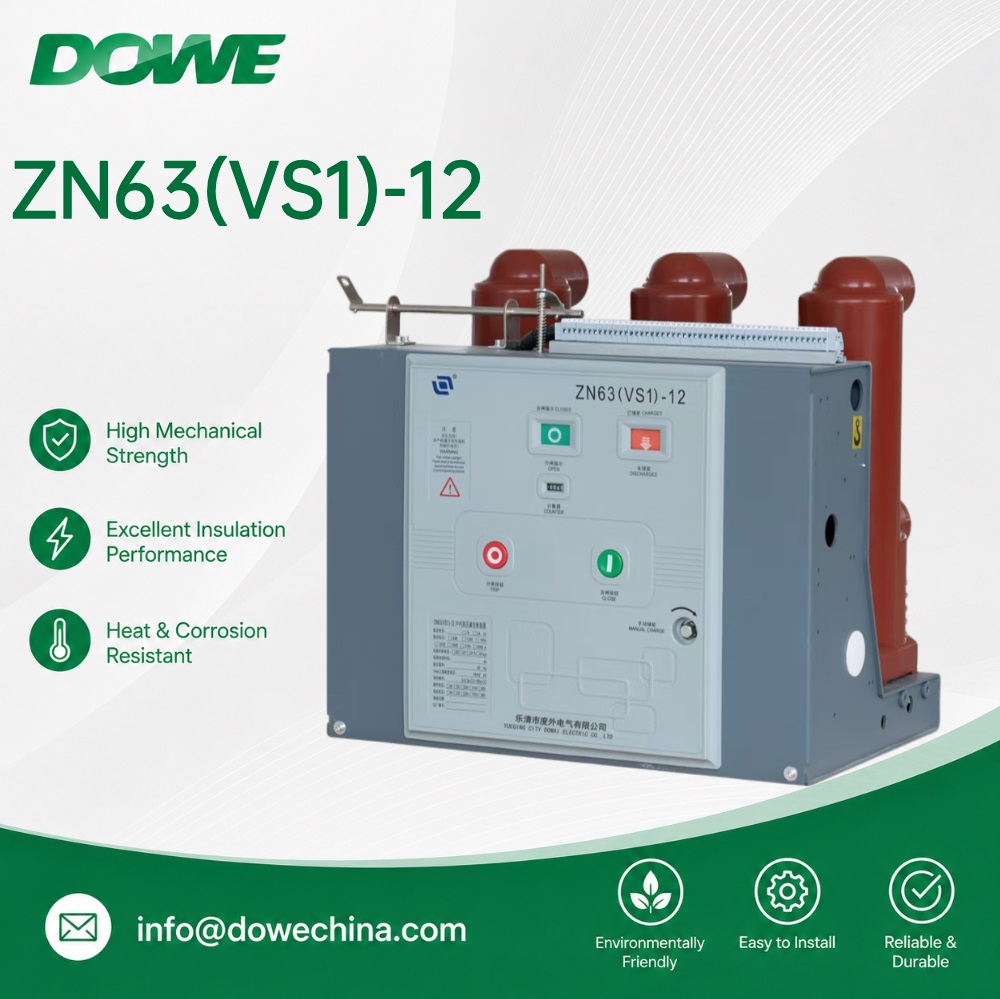
These converging pressures are why vacuum interruption technology has become the reference point for 12kV and 24kV indoor circuit breaker specification. Products such as the VS1-12, the VS1-24 / VSG-24 and the withdrawable VSG-12 are built specifically to answer these pain points, and their technical documentation offers a useful lens for understanding how the industry is responding to environmental, safety and maintenance pressures simultaneously.
Technical Principles and Standards Behind Vacuum Circuit Breaker Performance
Vacuum Interruption Mechanism
At the core of this technology is a sealed ceramic interrupter chamber evacuated below 10-3 Pa. When a fault occurs, the arc is extinguished inside this chamber, with metal vapor condensing at the first natural current zero. Because the interrupter is sealed for life, there is no oil to change, no SF6 to handle, and no arc chute to clean—removing the recurring maintenance tasks associated with older breaker technologies. Operation is driven by a spring stored-energy mechanism, using motor charging at AC/DC 110 V or 220 V with manual backup, which allows the breaker to complete an O – 0.3s – CO – 180s – CO auto-reclose duty even if motor supply is lost.
Rated Performance Across VS1-12, VS1-24 / VSG-24 and VSG-12
Built to IEC 62271-100 and GB/T 1984, these breakers cover the two dominant medium voltage classes: 12 kV and 24 kV. The 12 kV series (VS1-12 and VSG-12) delivers rated normal currents from 630 A to 3150 A, rated short-circuit breaking currents of 25 kA / 31.5 kA, and short-circuit making currents up to 63 kA / 80 kA peak. The 24 kV series (VS1-24 / VSG-24) is dimensioned for 20 kV and 22 kV networks with rated normal currents from 630 A to 2500 A, breaking currents of 20 kA / 25 kA, and a 230 mm pole centre distance sized for 50 kV power-frequency and 125 kV lightning impulse withstand levels. Both series are rated for mechanical endurance of at least 30,000 operations and electrical endurance of at least 10,000 CO operations at rated current—performance intended to outlast the service life of the switchgear cabinet itself.
Emerging Trends: Retrofit Compatibility, Climatic Adaptation and SCADA Integration
A significant portion of medium voltage demand is not new installation but replacement of aging assets. This is reflected in the dimensional compatibility these breakers maintain with VS1, VD4 and 3AH5 footprints, permitting direct replacement of obsolete oil, air-magnetic or early vacuum breakers without modifying the existing cabinet. This retrofit path avoids the capital cost and outage duration associated with full switchboard replacement.
Digital integration is another visible trend. Auxiliary switch blocks—available up to 13NO13NC—report breaker position, spring-charged status and trip-circuit supervision to protection relays and SCADA systems, while optional position indication contacts cover Service / Test / Isolated states on withdrawable configurations. The VSG-12 additionally supports optional motorised racking for remote or SCADA-based operation, reflecting a shift toward remotely supervised switchgear.
Climatic and regional adaptation also shape product development. Optional low-temperature grease and anti-condensation heaters support GOST 15150 climatic versions for CIS winter service, while 60 Hz verification is available for markets such as Saudi Arabia. Every unit, regardless of destination, is function-tested at minimum, rated and maximum control voltage—addressing the real-world condition of station battery voltage sagging during a disturbance.
Company Capabilities: Engineering Depth Across the VS1 and VSG Product Lines
Across the VS1-12, VS1-24 / VSG-24 and VSG-12 product lines, the underlying value proposition centers on reliable circuit interruption combined with reduced environmental obligations and minimal maintenance requirements. Vacuum interruption removes F-Gas reporting, leak-checking and end-of-life recovery obligations relevant to EU and Eastern European tenders, and the absence of oil eliminates fire load and oil disposal requirements entirely. Sealed vacuum interrupters need no oil changes, SF6 handling or arc chute cleaning, which suits markets where local servicing capability is constrained.
The manufacturing approach reflects a B2B product model targeting switchgear manufacturers and panel builders as core customers, supplemented by industry adaptation spanning utility distribution, industrial motor and transformer feeder protection, power generation, renewable energy collection points, and substation bus-section duty. Service capability extends to pre-order retrofit interchangeability confirmation, where a customer supplies the existing model, pole centre distance and mounting dimensions so compatibility can be verified before an order is placed. Stocked spare coils are maintained for African markets, and optional witnessed factory acceptance testing is available for SEC projects. Compliance evidence across the range includes IEC 62271-100, IEC 62271-200, GB/T 1984, EN 62271-100 and GOST R certification.
Conclusion and Recommendations for Switchgear Buyers and Panel Builders
The technical record behind 12 kV and 24 kV indoor vacuum circuit breakers points to a clear industry direction: interruption technology must simultaneously satisfy compliance obligations, minimize ongoing maintenance, and fit within existing switchgear footprints. For utilities and industrial operators evaluating replacement strategies, the retrofit compatibility with VS1, VD4 and 3AH5 footprints offers a practical path to extend switchgear service life without cabinet redesign. For panel builders and switchgear manufacturers sourcing components, confirming pole centre distance and mounting dimensions ahead of order placement remains an essential step to ensure interchangeability. Buyers operating in regions with limited servicing infrastructure should weigh the value of sealed, maintenance-free vacuum interruption against the recurring obligations tied to gas-insulated or oil-filled alternatives, particularly where mechanical endurance of 30,000 operations and electrical endurance of 10,000 CO operations at rated current are required to match the operating life of the surrounding switchgear.
Yueqing City DUWAI Electric Co.,LTD
www.doweelectric.com